In today’s world of instant communication, is the Spelling Bee competition irrelevant?
The comments on the eight winners of the 2019 American Spelling Bee competitions in an article in NYT vary from admiration, congratulations, even disdain .One reader reacts the said article and calls this challenge “anachronistic,” and it tests “one of the simplest measures of cognition.” Another commenter congratulates the hardworking children, and fondly reminisces over a time when language skills were valued before the digital world took over. Others disagree, and see learning languages and spelling correctly are not really important anymore with spell checks and programs like Grammarly. Several others suggest a vocabulary bee would be more relevant. The fact that most winners have ancestors of Indian origin cannot be overlooked. Some commenters even go to say the Indian parents force this burdensome path on the kids.
My take is simple. There’s much thinking and logic in spelling correctly. If I were given the word “anachronistic” to spell, I would ask for the origin if stumped. Of course, it would be Greek, and Chronos means time. I would find out the part of speech, figure out the prefix, and string it all together. It is neither a regurgitation exercise nor a lower cognitive function. The spelling also includes vocabulary and making connections.
I agree with all the congratulatory messages for the hardworking kids, and I hope someday they’re worthy of attention to find a place amidst the Kardashians.
For those who find this competition irrelevant in today’s digital world, I have a small story specially written for your pleasure.
One early morning, a friend sent me one chuckle-worthy picture via Whatsapp. It is the periodic table for today’s digital acronyms. I tried with much difficulty to find its provenance to attribute accurate photo courtesy. However, this creative piece has gone viral on several social media platforms without a definite attribution. For those who feast on them and emojis alike, here’s my humble dedication of a text story between two friends. Read the conversation and decode with the table below if you are from an older school.
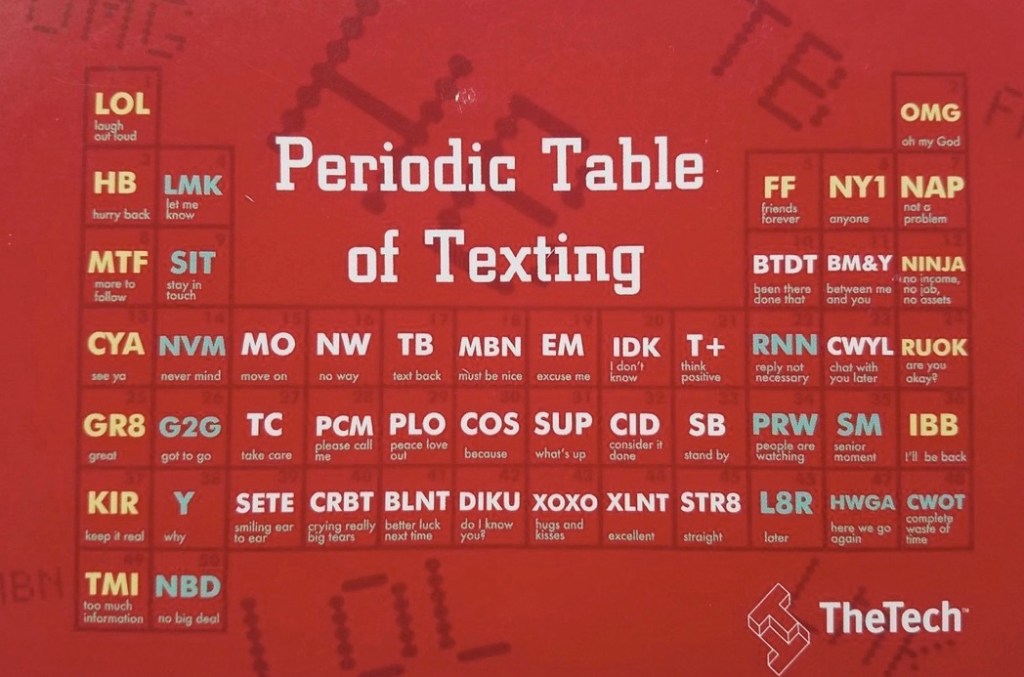
Photo Courtesy The Tech, as sent to author on Whatsapp.
Ron: FF, RUOK?
Jon: ;-(
Ron: Y?
Jon: Cos BM &Y, NINJA
Ron: T+
Jon: CRBT
Ron: CWOT 2 B ;-(
Jon: EZ 4 U, not 4 me
Ron: BTDT, KIR kid,
T2MO
Jon TY, for SB me
Ron: NAP never give up!
Jon: TY
Ron: NBD, TB, OK?
PLO
Jon: XOXO
A week later, some good news
Jon: FF
Ron:Sup?
Jon: No more NINJA!
Ron: XLNT! Cos T+
Jon: SETE
Ron: MBN, NJOY!
Jon: ❤ job!
TY 4 UR support! MTF, SIT
Ron: GR8! KIR kid! LTR!
Jon: XOXO!
And for those needing some expansion, HWGA.. (Here We Go Again)
Ron: FF, RUOK? (Friends forever, are you ok?)
Jon: ;-( (sad face emoji)
Ron: Y? (Why?)
Jon: BM &Y, cos NINJA (Between you and me, it’s because I have no income, no job, no assets)
Ron: T+ (Think positively)
Jon:CRBT (I am crying really big tears)
Ron: CWOT 2 B ;-( (Complete waste of time to be disheartened)
Jon: EZ 4 U, not 4 me (It’s easy for you to be that way, but not for me)
Ron: BTDT, KIR kid, (I’ve been there done that, so keep it real kid)
T2MO (It’s time to move on)
Jon TY for SB me (Thank you for standing by me)
Ron: NAP!, NGU! Not a problem, never give up!)
Jon: TY (Thank you!)
Ron: NBD, TB, OK? *(No big deal, text back, ok?)
PLO (Peace, love, out!)
Jon: XOXO (hugs and kisses)
A week later, some good news
Jon: FF (Friend forever)
Ron: Sup? (What’s up?)
Jon: No more NINJA! ( I found a job, have some money and assets)
Ron: XLNT! Cos T+ (Excellent, because you thought positively and acted upon it)
Jon: SETE (Smiling ear to ear, so happy now!)
Ron: MBN NJOY! (Must be nice, enjoy!)
Jon: ❤ job! (I love my job)
TY 4 UR support! MTF, SIT (Thank you for your support, more to follow, I will give you details, so stay in touch)
Ron: GR8! KIR kid! LTR! (Great, keep it real kid, see you later!)
There, I tried to fit in, this product of an older time. If you love the origin of languages, and enjoy finding clues in words or learning new languages, then the worth of this competition is clear. Through spelling clues, one can learn about a whole culture. An example of a lake in Switzerland called by several names by Swiss/ Germans, French, and Italian would respectively be Luzern, Lucerne, Lucerna. Pronunciation is different and so is the spelling. It takes a lot of thought to be a Spelling Bee beyond mere memorization.
To those who disagree, I will use the expanded acronym in conclusion; Peace, Love, Out!
 theinkybee.com