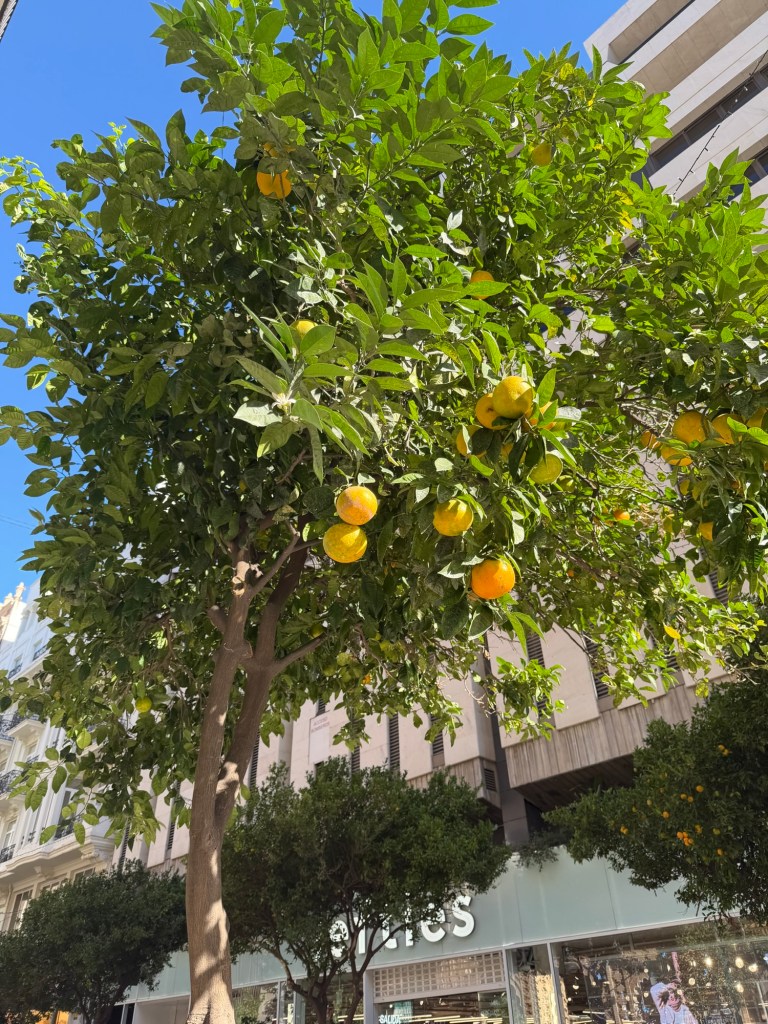
There’s more to València than Oranges
Valencia surprised me long before I reached the City of Arts and Sciences, but it was Calatrava’s white-boned dreamscape that made me pause. I felt it even before I understood it in the sweep of impossible curves, the tension between earth and sky, the suggestion that buildings can stretch, breathe, swim, or even take flight. Born in València, the artist returned with the confidence of someone who knows exactly what light does in this city. If almost feels like he’s speaking his mother-tongue. Keeping this in mind, I will stick to the original Spanish names and accents. Now sitting on the train to Madrid, I can revisit the place I leave behind.
We took the Tuk-tuk tour with our guide Lude, and she was extremely pleasant and informative. She understood why I was moved by this particular architect to answer all my queries in the most excellent manner.
Calatrava’s architecture is bold, it takes chances and it will not, shall not, need not apologize. That’s the kind of artist I would wish to be if I could. The separate buildings are bound together. and the Palau de les Arts looks like a ship that feels like it could sail away if the Mediterranean wind insisted hard enough. Valèncians like the Catalunyans, say Palau for palace, while others call it palacio.

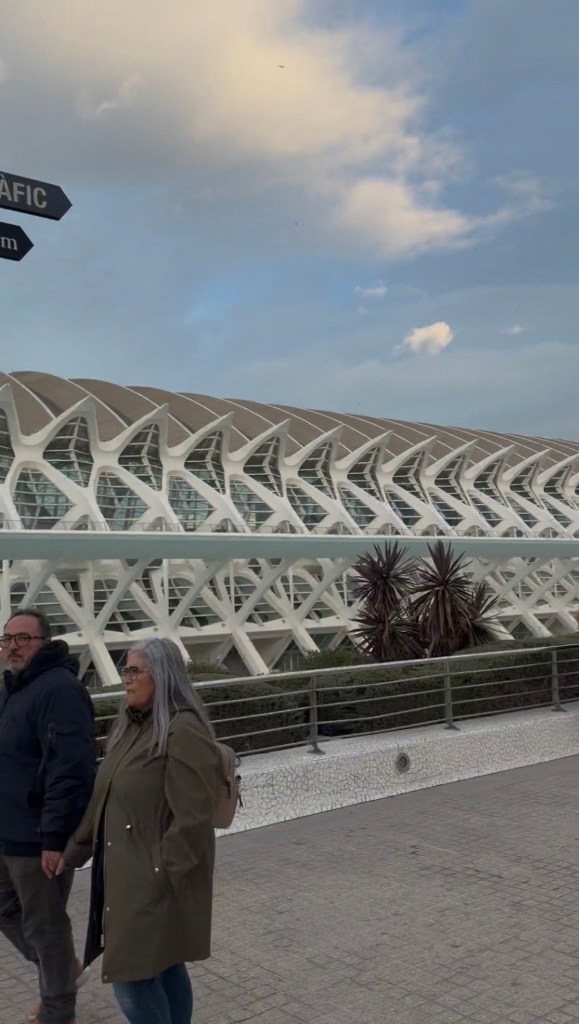

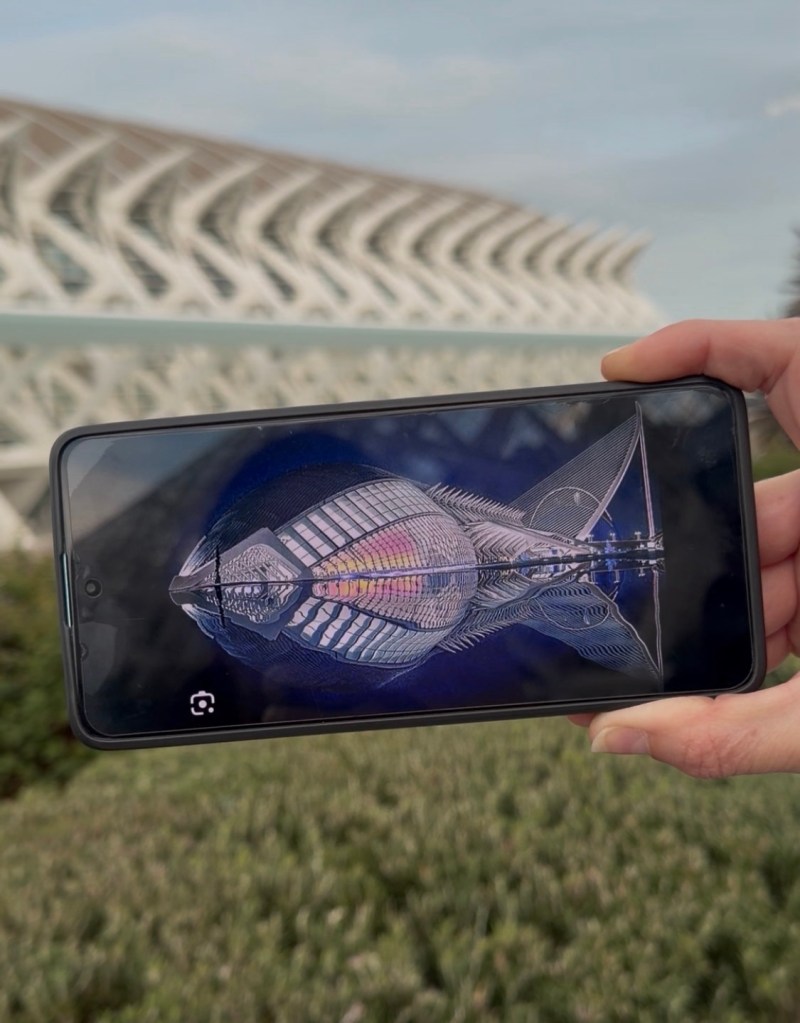
The Hemisfèric gleams like an eyelid half-open. It is a planetarium and IMAX theater. The Museu de les Ciències pulls you forward with its ribcage silhouette. The Assut de l’ Or bridge, not golden but white, looks like fish fins. The reflecting pools extend these structures to pull them all together. It looks like a ship on one end, while the fish in between is being chased on the other end by a blue shark. Our guide Lude put that in my mind. That shark mouth is the Àgora building. If is tiled deep blue, and is oval-shaped, that many say represents a vertical, oval shell. For me now, it is a blue shark behind the fish. Look at the picture above and the one Lude showed me and dare to disagree. Cultural events are held in the Àgora.
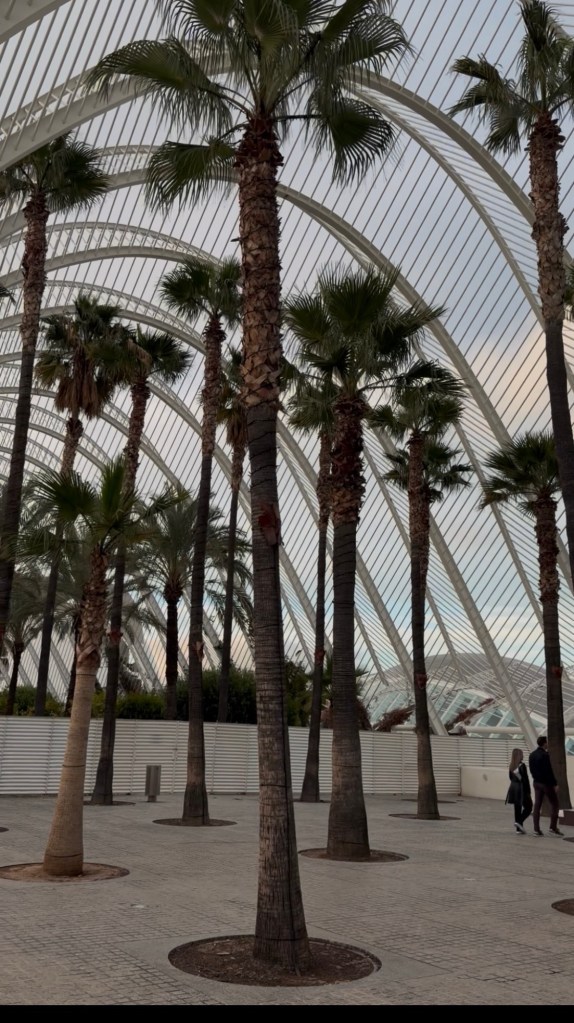
The blue and white broken mosaic tiles in front of the structures imitate waves, and Calatrava seems to have thought of all details. For example, the benches are ergonomically designed with a little dip at the back for better seating comfort. He chose light-reflecting white over the Mediterranean blue, so people do not burn their behinds in the Valèncian sun. The dappled shade is provided by modern latticed rods that he visualizes as a large umbrella. What struck me most was the way these structures reshape ordinary human movement. Each person whether a child, adult, or youngster shapes the structure in their own way.

Don’t criticize the architect for his extravagance or ego, for when you stand there, you get the elemental idea that public spaces should astonish like this with a stunning impact. I feel we landed here at a time people still do not realize his huge contribution. Time will change that.
The architect dares to make City of Arts and Sciences feels less like a monument and more like a conversation. Whether it is between water and steel, between past and future, or a conversation between a visionary architect and the place that formed him, the city of València didn’t just commission Calatrava, it absorbed him. However, it’s an even exchange. The city allowed itself to dream as boldly as the man it raised, and it will be defined by him in future.
 theinkybee.com