Valencia surprised me long before I reached the City of Arts and Sciences, but it was Calatrava’s white-boned dreamscape that made me pause. I felt it even before I understood it in the sweep of impossible curves, the tension between earth and sky, the suggestion that buildings can stretch, breathe, swim, or even take flight. Born in València, the artist returned with the confidence of someone who knows exactly what light does in this city. If almost feels like he’s speaking his mother-tongue. Keeping this in mind, I will stick to the original Spanish names and accents. Now sitting on the train to Madrid, I can revisit the place I leave behind.
We took the Tuk-tuk tour with our guide Lude, and she was extremely pleasant and informative. She understood why I was moved by this particular architect to answer all my queries in the most excellent manner.
Calatrava’s architecture is bold, it takes chances and it will not, shall not, need not apologize. That’s the kind of artist I would wish to be if I could. The separate buildings are bound together. and the Palau de les Arts looks like a ship that feels like it could sail away if the Mediterranean wind insisted hard enough. Valèncians like the Catalunyans, say Palau for palace, while others call it palacio.
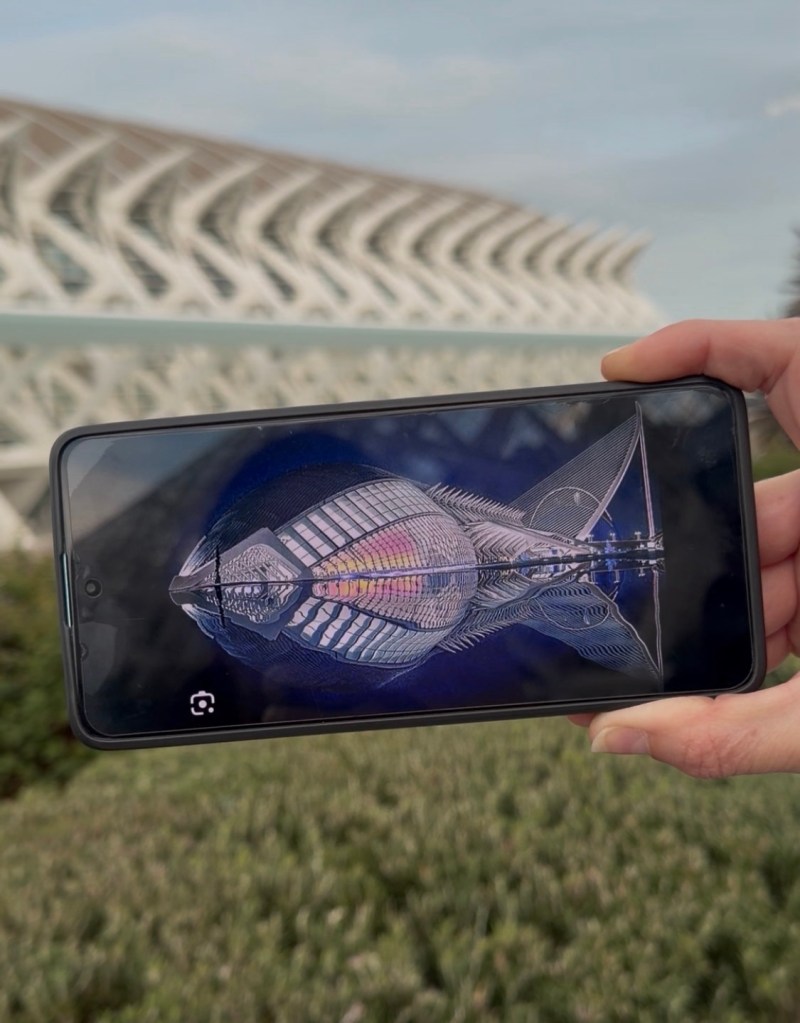
The ship and fish headThe ribbed fish bodyThe fin and shark following fish fin
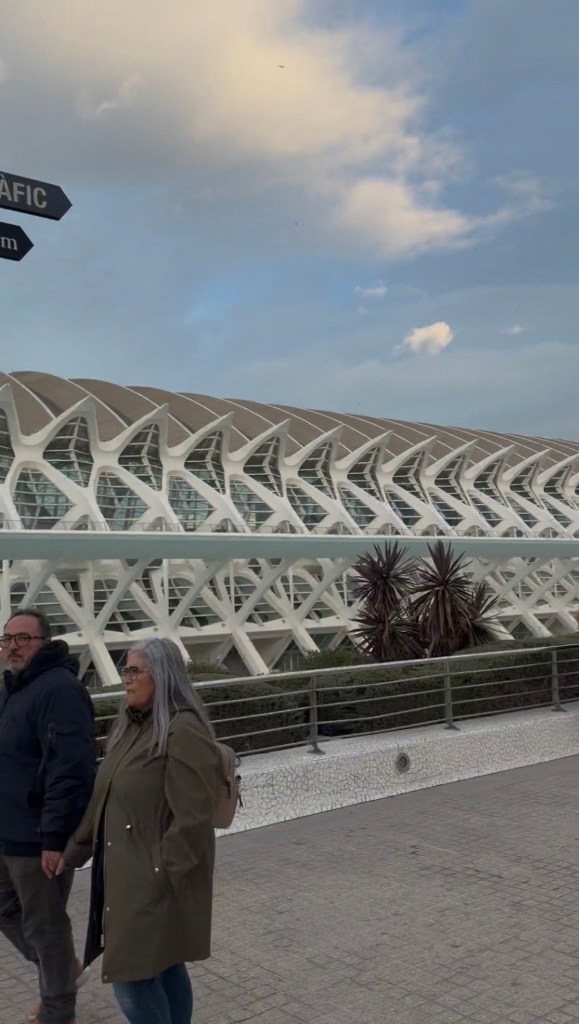
The Hemisfèric gleams like an eyelid half-open. It is a planetarium and IMAX theater. The Museu de les Ciències pulls you forward with its ribcage silhouette. The Assut de l’ Or bridge, not golden but white, looks like fish fins. The reflecting pools extend these structures to pull them all together. It looks like a ship on one end, while the fish in between is being chased on the other end by a blue shark. Our guide Lude put that in my mind. That shark mouth is the Àgora building. If is tiled deep blue, and is oval-shaped, that many say represents a vertical, oval shell. For me now, it is a blue shark behind the fish. Look at the picture above and the one Lude showed me and dare to disagree. Cultural events are held in the Àgora.
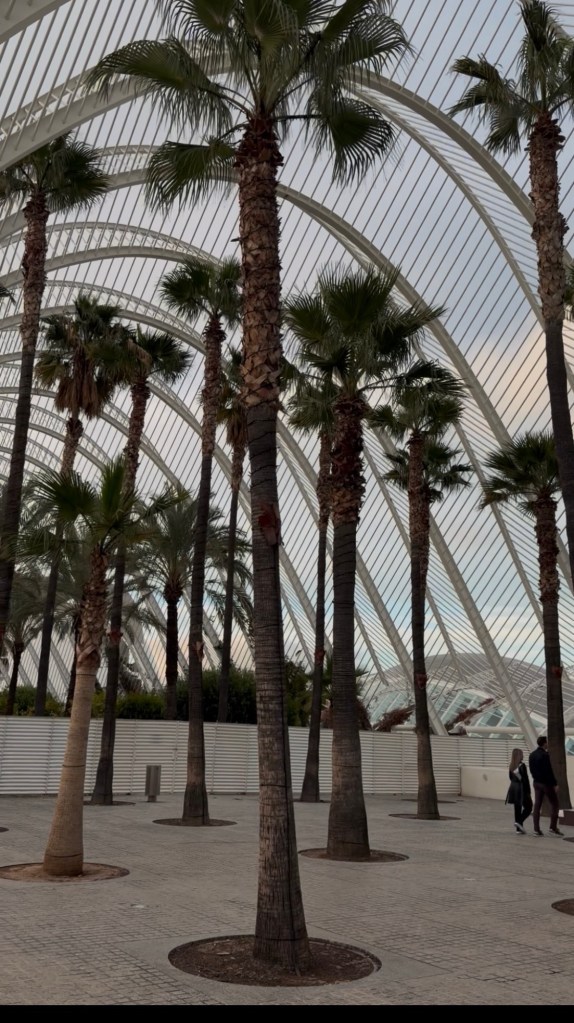
The blue and white broken mosaic tiles in front of the structures imitate waves, and Calatrava seems to have thought of all details. For example, the benches are ergonomically designed with a little dip at the back for better seating comfort. He chose light-reflecting white over the Mediterranean blue, so people do not burn their behinds in the Valèncian sun. The dappled shade is provided by modern latticed rods that he visualizes as a large umbrella. What struck me most was the way these structures reshape ordinary human movement. Each person whether a child, adult, or youngster shapes the structure in their own way.
The blue and white Mediterranean wavesThe dappled shade for visitor comfort and visual esthetic
Don’t criticize the architect for his extravagance or ego, for when you stand there, you get the elemental idea that public spaces should astonish like this with a stunning impact. I feel we landed here at a time people still do not realize his huge contribution. Time will change that.
The architect dares to make City of Arts and Sciences feels less like a monument and more like a conversation. Whether it is between water and steel, between past and future, or a conversation between a visionary architect and the place that formed him, the city of València didn’t just commission Calatrava, it absorbed him. However, it’s an even exchange. The city allowed itself to dream as boldly as the man it raised, and it will be defined by him in future.
Sometimes meaning arrives slowly, long after creation
Today, I combined two unrelated sentence fragments while experimenting with a new book structure. To my surprise, I had accidentally created a quote that invited deeper philosophical exploration.
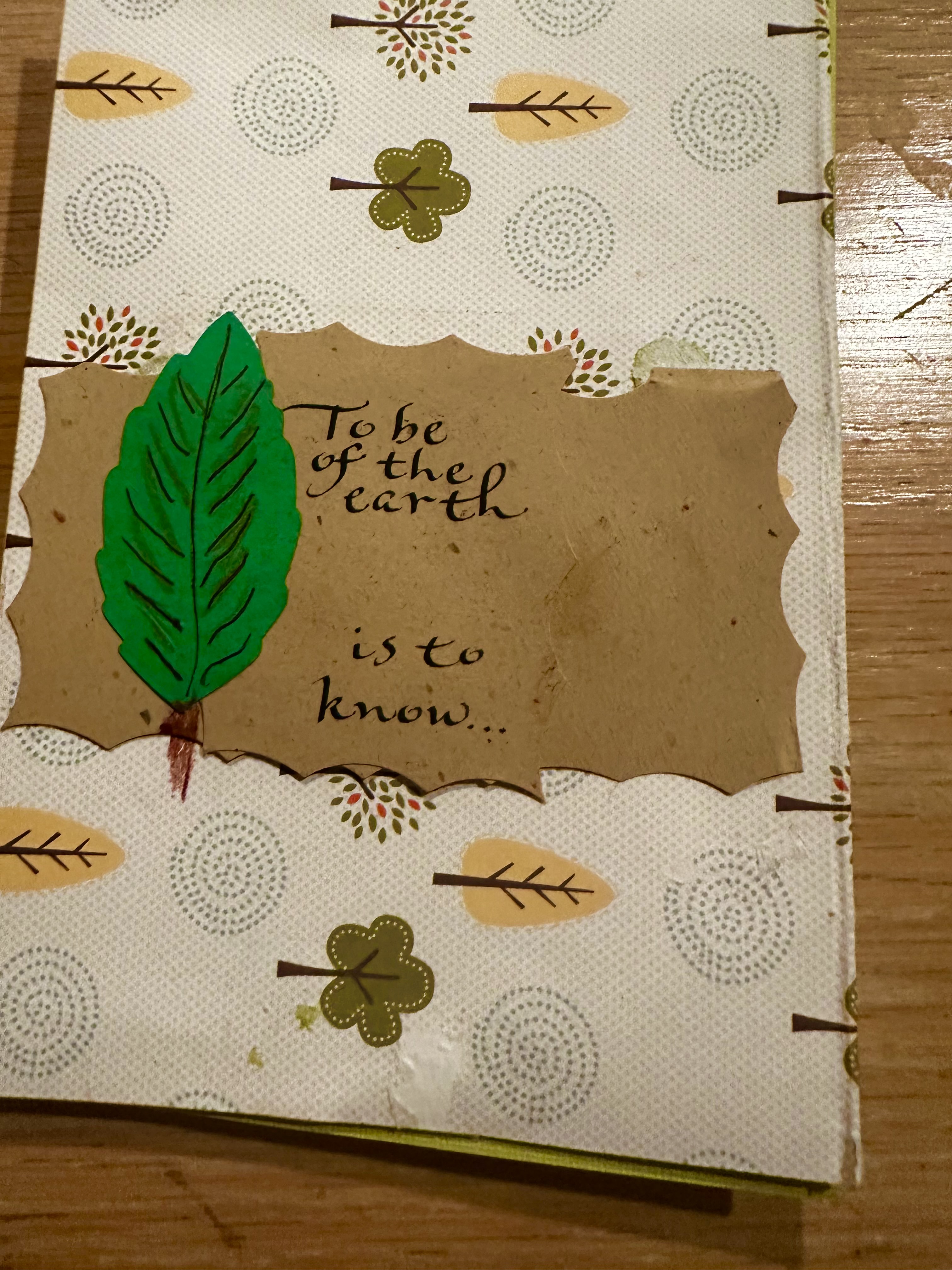
I like to create a bit of something everyday. I saw this structure in a demo by a book artist. My rotating book has tuck pockets and hidden spaces. Its cover, wrapped in patterned paper of trees and greenery, asked for something more. I confess I’m a” paperholic.” I pulled out a scrap with a random part quote. It said, “To be of the earth is to know…” It gave some resolution about seeds, growth, and life cycle. I was not impressed, but the part sentence held much promise.
For the last page, I drew a tree and put a sticker next to it, that simply reads, “life takes time.” It was from a task reminder prompt, totally unrelated to the quote. Yet, it had possibilities.. So, I added three dots before the sentence to join it to the initial quote segment.
To be of the earth is to know…life takes time.
On the face of it, the sentence sounded right. so I left it alone, focusing more on the book.
With the structure complete, I felt something seemingly subtle, persistent, and perhaps contemplative. I knew then that I had to return to the quote. Could there be something more in this innocuous conjoining?
Nature doesn’t rush. Trees begin as seeds, growing slowly over time. Rivers carve canyons through stone across millennia. Seasons unfold with steady patience. Yet humans so often forget this, caught in the rush of our days and wasteful ways. We forget destruction isn’t just about what’s lost physically, but time we can never reclaim.
Are we now rapidly becoming the cause of imminent destruction while simultaneously searching for a peaceful panacea? We teeter between diplomacy and aggression. Perhaps we should listen to nature instead of ourselves.
It’s this disconnect from nature’s pace that leaves us restless, always reaching, always rushing. But there is another way. To be of the earth means tuning into that quiet rhythm. Releasing the need for instant results and allowing life to unfold on its own terms can be life-affirming . To be of the earth is knowing there are no exclusive memberships.
Was there something subliminal or was it just a happy accident when I put together two disparate sentences? This created one single truth in a single quote of my making. I may never understand how life often surprises me, but I do know it can be such an unexpected delight.
I joined an online four-day bookmaking challenge. I love paper and have several beautiful selections. However, I like to create my own art. For this, I collected all ugly gel print scraps, ripped the nice parts, dug into my recycling bin, got some used teabags, lace, scrap fabric, words from magazines, color copies of experimental doodles, tissue, watercolor, and copier papers. I collaged it at all to 300 GSM watercolor paper. Amidst this chaos, I brought out metallic watercolor paint and left over coffee to drink, splatter, splotch, and spill with intention.
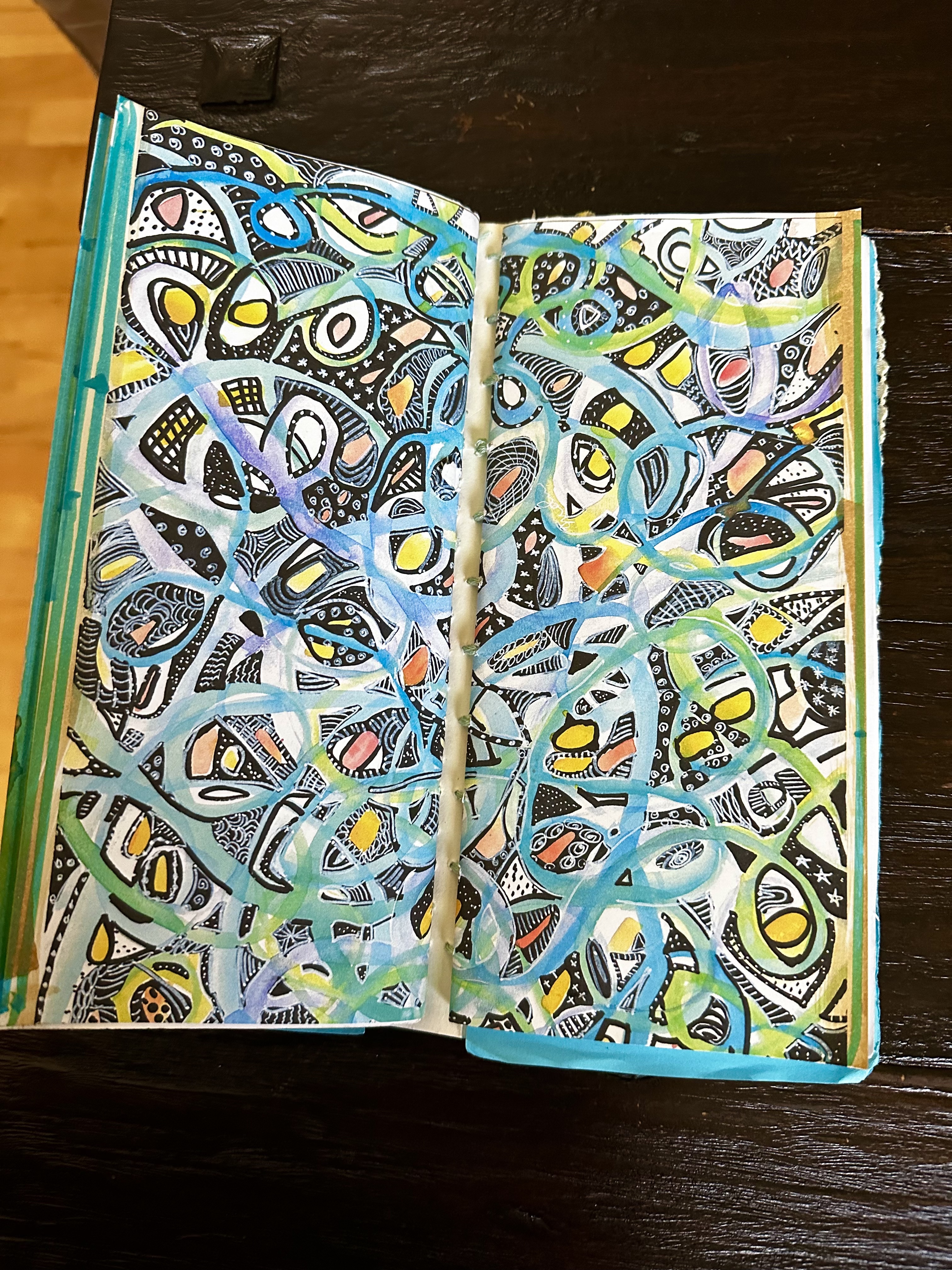
When the cover was out of the way, the real work began. I created the spine and signatures, the binding holes and began sewing. Between the zigzag stitches, I lost and retracked, adapted and adjusted, squinted and focused, tangled and untangled, pricked and jabbed, and tested myself several times. I truly feel I must lose myself several times just to rediscover the path. I practiced the enduring power of patience repeatedly through this exercise. There were moments of frustration, confusion, and doing over. Never once did I feel like giving up. I persisted and voilà! My book baby was birthed on schedule.
The result is totally worth it. I love the pages waiting to be filled with thoughts, dreams, and images. The book may not be as beautiful and artistic as the those of artist friends in the inspiration gallery. But it stands as testimony of my patience.
There is often the chatter of esthetics, artistry, technique in our heads. However, the biggest high for me came in the form of completion.
So, what can I discover with a challenge?
Trying something new can tap out potential and bring forth learning opportunities. Apart from a skillset, there is also learning about the resilience and patience within to complete a challenge.
I love to push myself out of my comfort zone. This original analogy pops up in my head when I get too comfortable. Imagine being a bicycle rusting in the rain instead of one that can ride beautiful trails, enjoy wonderful vistas, and experience new places and spaces. Challenges bring forth effort and the joys of discovery.
When thoughts fly without clarity or focus, these challenges provide purpose and direction. Taking on a small challenge and completing it makes me confident to tackle larger ones.
There is a sense of accomplishment when the sticky aspects of the challenge are solved, and the job is successfully completed. This feels like an exercise to persevere and overcome life’s adversities.
Most of all, I love challenges because there is an inbuilt association with humanity. These represent my passions, deepest desires, and dreams. I feel I can achieve when I dare to dream, learn from others, share my ideas and thoughts, and have faith in my ability. Even if I fail the first attempts in the challenge, I know the next trial could be smoother.
The frustrating part is getting stuck. I walk away knowing there is always a possibility of coming back to the unfinished one. Stepping back for a brief while brings new energy and a different perspective..
Of course, there are challenges one must release. Persevering is different from perseveration. If I cannot solve it, there is always some other challenge I can try. It is not giving up but letting go.
Looking back, a challenge gives me options to try something different within the challenge. Minimalism is hard for me, and I keep adding things to my book. My next challenge would be making the same structure with a minimal outlook.
A challenge is truly successful when there is a sadness after the joy in the completion. I often forget the frustration and somehow yearn for the high points.
The runaway experiments with printing on paper have left behind stacks of results. I’m constantly looking for ways to use them. A kind friend artist Linda Powers introduced me to the world of gelatin printing, and I can’t stop playing.
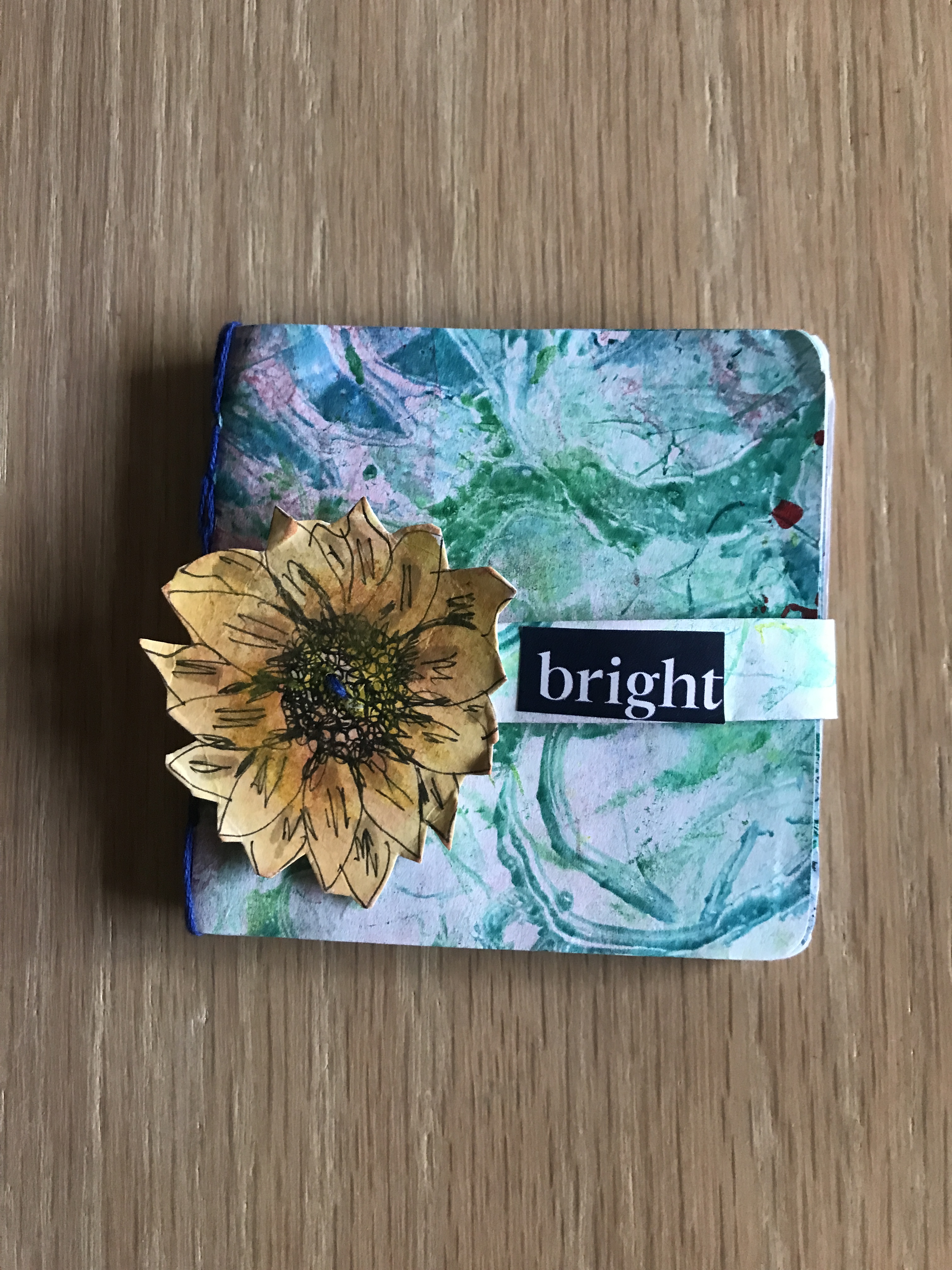
Today I made a mini book with chain-stitched spine using the colorful prints, some embroidery floss, a random sunflower I had once doodled.
UNBLOCKING BY BLOCKING
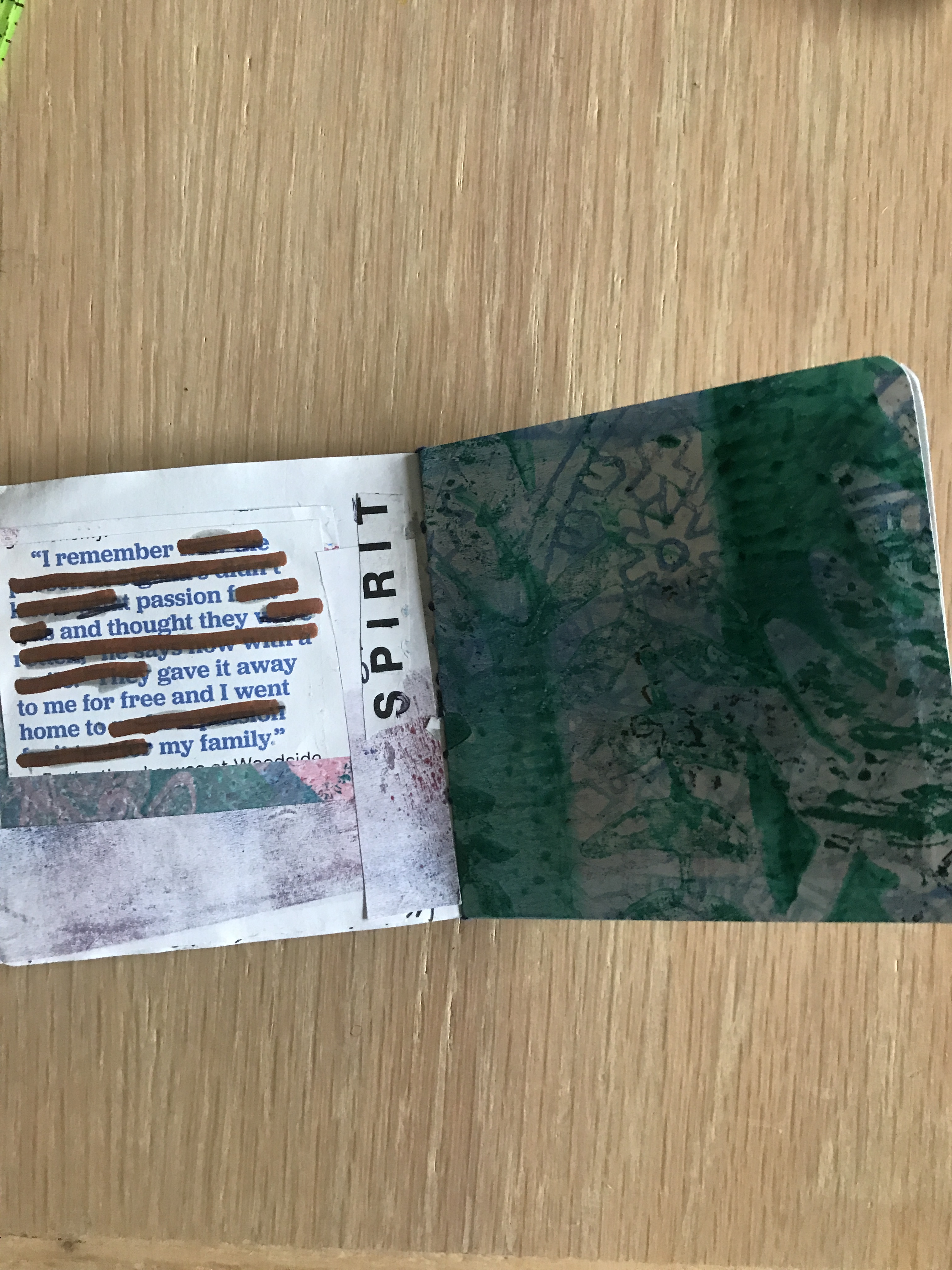
The pages were colorful, but they lacked words. I wanted to exorcize my block by selectively blocking someone else’s words. I culled out paragraphs and quotes from PUNCH magazine to do this.The altered meaning inspired a play with poetry.
I blocked out part of what a chef called Charlie quoted about a childhood memory. The resulting words came out this way. “I remember passion and thought they gave it away to me for free, and I went home to my family.”
But what did Charlie really say?
Here’s his quote noted by the magazine.
“I remember how the person at Sigona’s didn’t know what passion fruit was and thought they were rotten,” he says now with a smile. They gave it away to me for free, and I went home to make a passion fruit tart for my family.”
Here’s an unaltered poem I am writing from my stream of consciousness arising from selecting someone else’s words.
SPIRIT
I remember I remember
For long as I can remember,
a passion burns within.
I looked at my parents
and thought
they gave it to me.
I looked at kindred souls
and thought
I got it from them.
I looked at movers,
I looked at shakers,
I looked at doers,
and thought
they gave it for free.
Catalysts
all of them..
I traveled hither
and I traveled tither.
I went home
to my family
to see
the spark
and
igniter
were actually
within me.
It strikes me now that passion is never given away but it’s shared. With sharing and acceptance come growth. So I create, hopefully inspire, and continue getting inspired.
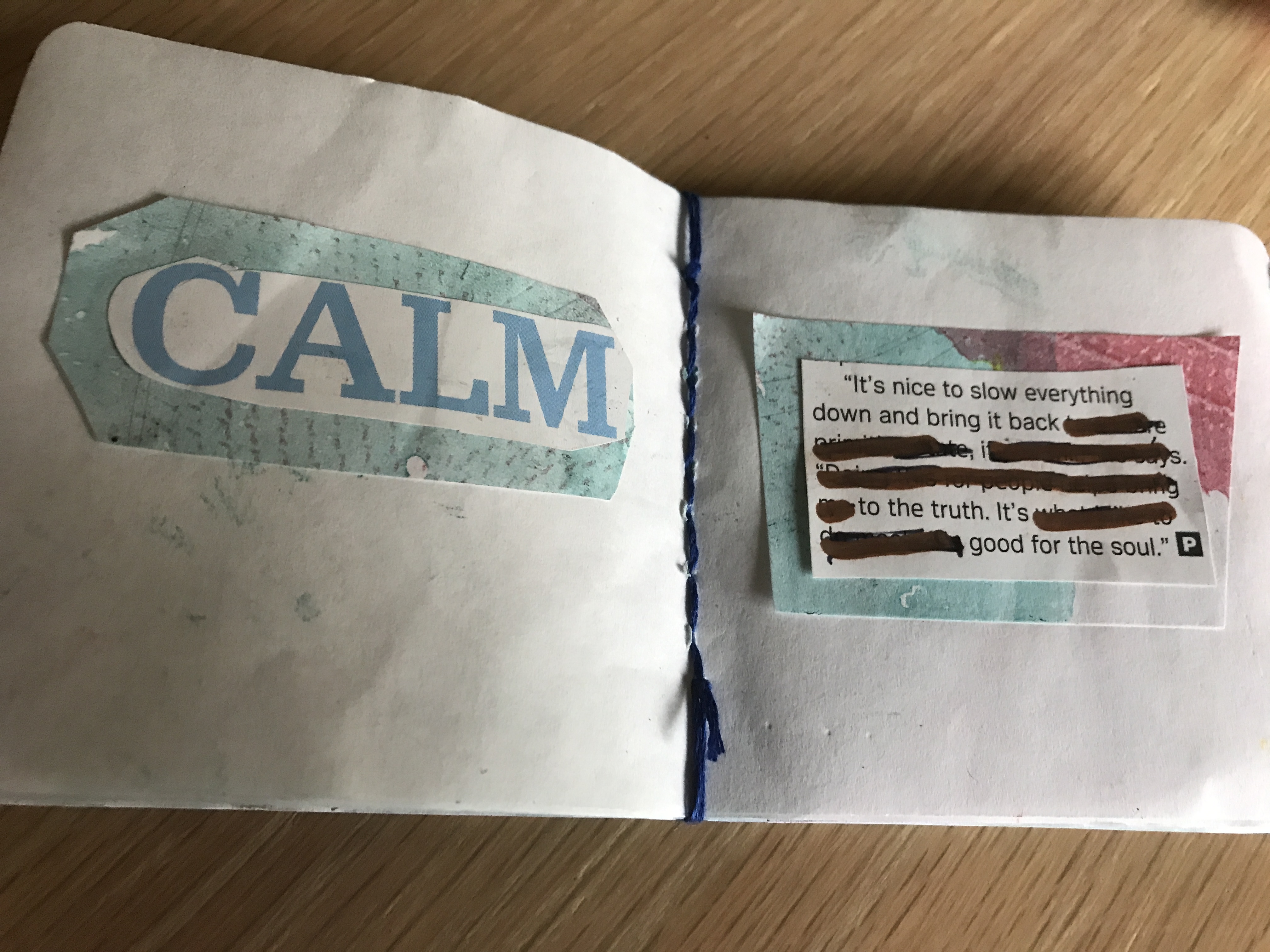
Here’s a quote I altered. The slow mindfulness I experience with creativity made these words pop among all others. “It’s nice to slow everything down and bring it back to the truth. It’s good for the soul.”
This truth in slowness exists everywhere. Whether it is taking the time to smell the roses or appreciating the moment, this truth is good for the soul.
Oh, her quote was about slow cooking and soul food.
This one is an altered quote from Lindsey in the magazine who makes organic granola bars.
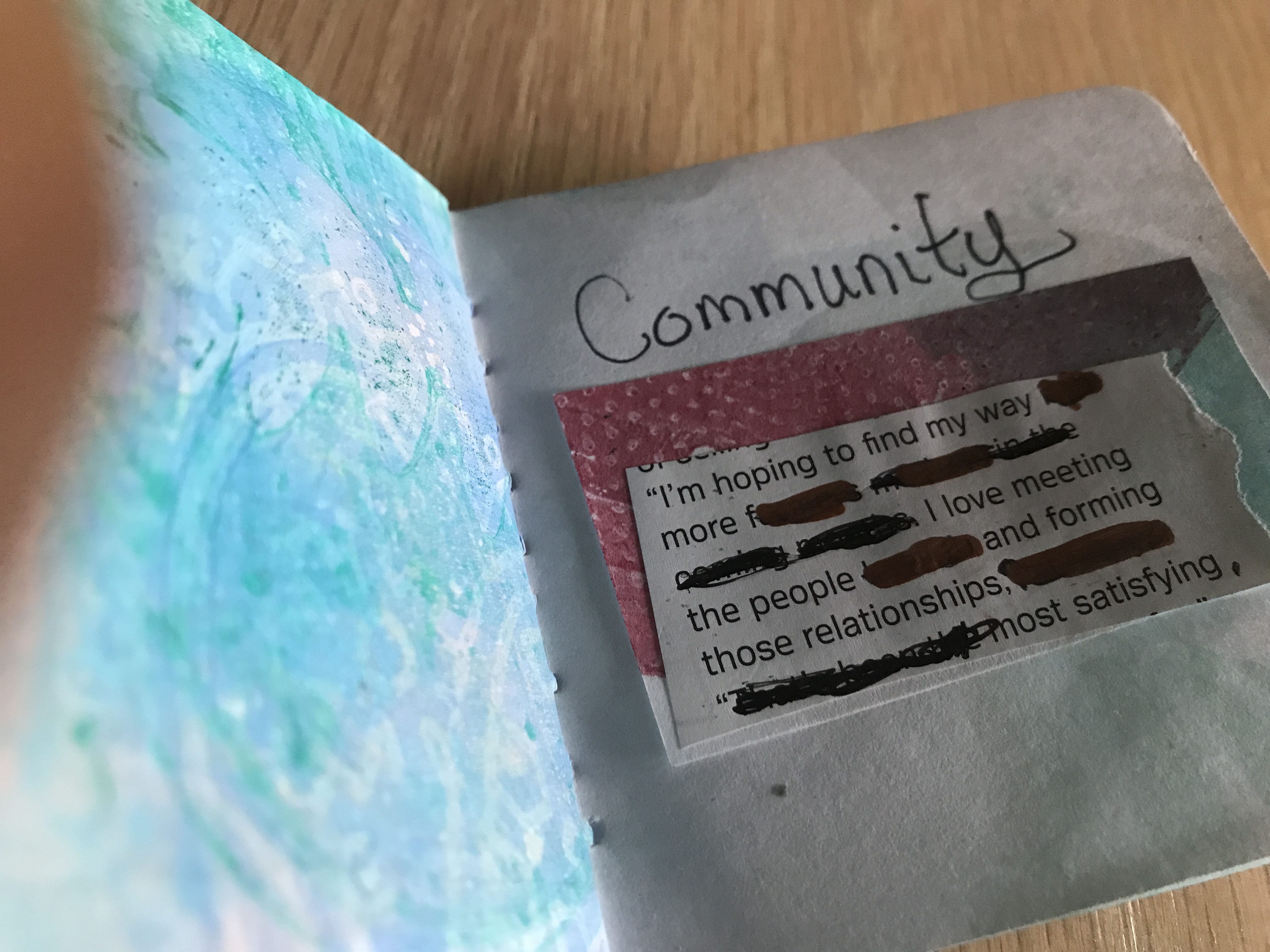
If there’s one thing the pandemic has taught us, it is the importance of community. Virtual ones have mushroomed everywhere only because creatures have a pressing need to connect. “I’m hoping to find my way more. I love meeting the people and forming those relationships most satisfying.”
Yes, it is most satisfying to meet others and form new relationships.
The current time has blurred many a path for many, but I’ll find my way back to community, strengthen old relationships and forge new ones.
Here’s the original quote. “I’m hoping to find my way into more farmer’s markets in the coming months. I love meeting people I sell to and forming those relationships.”
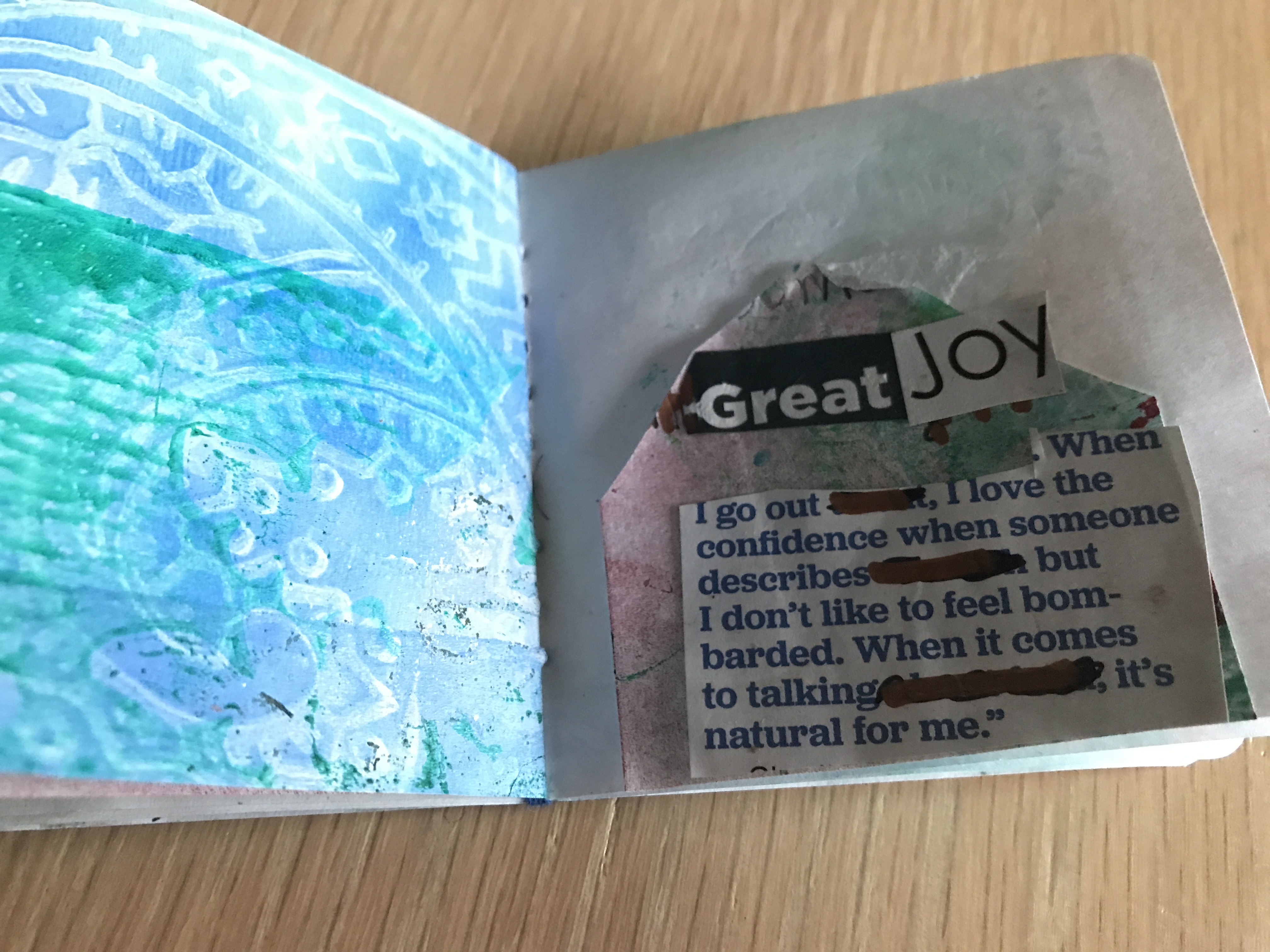
I call this Great Joy
“When I go out, I love the confidence when someone describes but I don’t like to feel bombarded. When it comes to talking, it’s natural for me.”
This altered quote brought out my chatty spirit and curiosity with knowledgeable discussions. I do find great joy in this. Yet, I can fine-tune the self. I realize I don’t like being bombarded. It gives me an opportunity to extend a courtesy not to bombard others. I choose to allocate more time to active listening and be that much better off.
The original quote by chef Charlie refers to his interest in giving details about the dish he serves with the right balance. “When I go out to eat, I love the confidence when someone describes the dish but I don’t like to feel bombarded. When it comes to talking about food, it is natural for me.”
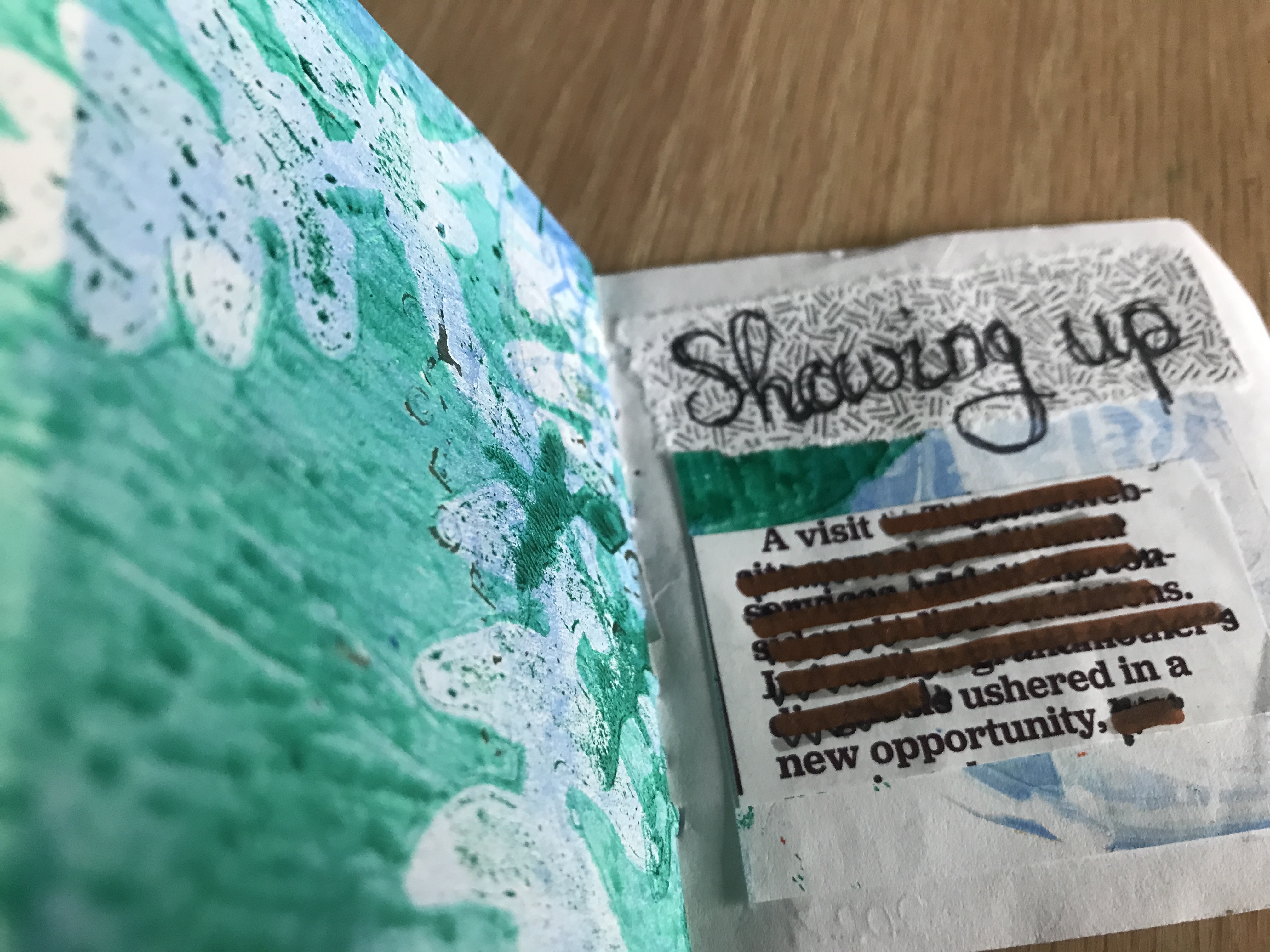
I call the next block, “Showing Up!”
Taylor is a baby name specialist. I’d have skipped through the article if I were not looking for a snippet to alter. It’s interesting how an ascribed baby name can play a part in influencing the grown individual’s persona.
The magazine author quotes,”Just as her grandmother’s diagnosis ushered in a new opportunity, her passing also created space for Taylor’s interest in childbirth and spiritual and energy healing.”
My altered quote,”A visit ushered in a new opportunity,” reiterates the importance of showing up. It acts as a counterbalance to isolation. Showing up is not just turning up at a venue physically, but being there to do one’s part to help self and others. Showing up is to take on something new and finish it. It also is taking responsibility for things that did not go right. I constantly challenge myself and show up by completing my task. I try to give back to those who show up for me. When I show up, it automatically ushers in a new opportunity.
The Power of Stupidity is Stronger than You Think.
Photo Courtesy, Author
“This is your brain, and this is your brain on drugs.”
Remember the anti-drug video? It was most effective in its poetic simplicity by eliminating the Chicken-Little scare tactics. The egg and brain visual was so compelling that many addicts went cold-turkey!
Simplicity’s the key in making people think.
Never underestimate the power of stupidity. It’s a real thing with us humans. Sometimes I wonder how much longer we can go on with a lazy brain and resulting inaction.
“Save the Planet,” “Climate Change,” “Go Green!” They sound simple, right? Well, not really. They’re seen as buzz words, buzz kill, and carry with it the excitement level of an old turkey buzzard. Despite the best intentions, it’s not working, people!
Truly, Climate Change is a hard thing to grasp, but it is a serious and real issue.
We’re all experts thanks to electronic data dumps. A cause that would benefit living beings is argued, debated, decried, and “partisanized.” (pardon the neologism!) We all do a disservice by not changing our patterns in dealing with serious issues by standing on two sides.We’ve become intellectually lazy and this in turn has clogged our action potential.
“Save the planet,” is another misunderstood sentence. I just don’t get how clueless humans want to save while continuing to trash the planet. Sanctimonious stupid is also a thing, for Earth is a no-nonsense mother.
Remember the dinosaurs acting up? She probably tolerated much, until those recalcitrant creatures refused to toe the line. Mother Earth simply ushered in the Ice Age, turned off the lights, and took a long nap.
So, if anyone needs saving, it is us!
All creatures are interdependent in the web of life. Yet, we cannot see threads in the web breaking because there are several others holding up the web.
“Save ourselves!” would be a better motto. We humans listen better when it is about ourselves.
Someone came up with a National Bee Day. I’d say it was a thinking soul, amen! They become rarer every minute of the day. Now, if the brain was a free app, there would be a rush to use it, but I digress. Many only understand the bee’s sting. Some raise a hue and cry about hives, allergies, shock, and annoyance. Why care about the bee when it can all be about me?
Circling back to us seems more effective. It’s not just about saving the bees. You see, without them, there will be food scarcity. And with that comes starvation for us; you and me. Yes, me!
Every third mouthful we eat is pollinated by these hardworking creatures.
Pesticides, pollution in water, air, and ground cause hive collapse. As we continue to overpopulate, overuse, we overwork everything around us. There’s a direct correlation between human overpopulation and bee death. We push our agri-farms with pesticides and fertilizers to increase crop production for our ever-growing needs. According to UCLA’s apiculturist Eric Mussen, biologists have discovered “pesticide cocktail” of over 150 different chemical residues in bee pollen. This does not affect only the bees people, it affects us.
Those high-rise luxe buildings, those mega mansions, those trees we clear for our beautiful habitats, they’re not cheap. We raze down green habitats as well as the creatures that reside in them. But hey, it’ll not affect us in our climate controlled bubble with a penthouse view.
Let me break my own bad news. I’m not invulnerable. There’s a strong link between several creatures and the viruses harmful to humans. These detrimental viruses do not harm the creatures that consume them. Without these consumers, we have to fend with new diseases with cures that may have once existed in the forests that once existed. To put it simply, it’s like having dragonflies in the garden. With their monstrous appetite, they munch on mosquitoes and other insects that are harmful to humans.
Even in this oversharing climate, pesticide companies will not share the data on hive collapses. Bee pollen now contains traces of multiple pesticides that go on to the hive leading to their collapse. The food pollinated by the bees also carry trace pesticides. How can that not affect the consumers?
Apart from the other toxicities in pesticides, three neonicotinoids target the insect nervous systems. Not only do they accumulate in individual bees they infiltrate entire colonies including the honey. The infant larvae are affected as their food source is tainted, and they slowly become weaker. The stronger ones overwork, and the over-all effect is the bee colony collapse. Contrast these bees with the ones in a wild habitat, and there is a huge difference in survival. Wild habitats of course, are becoming rarer, and the increase in bee colony collapse is plain to see…that is, if one wants to see it.
Are there innovative ways to farm then?
Sometimes innovation is going back to the old ways. We need to restore ecological agriculture. That includes stabilizing human food consumption, preservation of wild habitats, and yes, protecting the bees. By avoiding large monocrops, we preserve ecosystem diversity and protect helpful insects.
Think about the Amazon forest with its rare plants, some medicinal, and all the special creatures inhabiting them. Now think about the clearing of these forests to meet the demand of a monocrop of soyabeans for human consumption. This is just unfeasible in the long haul.
Natural composting increases soil nutrients, it avoids toxic chemicals that suffocate the bees. In addition, ecological agriculture prevents wind and soil erosion, and mainly avoids pesticides and insecticides. With increased bee population and their good health, there is increased pollination with higher crop yields. Some countries have banned genetically modified crops that stifle out native plants that sustain bees.
Several countries in Asia, Europe, and South America are going back to ecological agriculture. Bhutan in particular, promotes organic farming only. It has banned all other kinds of farming. Regarding the bee population decline, there’s a silver lining. European Commission’s two year ban on certain pesticides affecting the bees will simultaneously study the recovery rate of bees. The long term ban on such pesticides is also on the table.
Despite warnings, the EPA in the US has turned a blind eye on the neonicotinoid pesticides to allow their use. This comes despite US Department of Agriculture’s warning on their use and the imminent bee hive collapse.
The Monsanto Protection Act of 2014 actually gives protection to the biotech companies by providing them immunity in federal US courts from damages caused by their commercial compounds to people and environment. This was written by their powerful lobbyists. US can and should do better, leading by example. If we were thinking individuals, these lobbyists would face some censure.
Everyone can pitch in to cultivate their” beesness.” At home, one can ignore the well-manicured lawn to allow a wilder habitat. It’s a good idea to do away with pesticides and chemical fertilizers. Planting native plants help local bees do their thing, and even filling water in a bird bath with pebbles provides them hydration. While you’re at it, encourage local apiarists with a purchase of local honey.
Now why would we have to put in this much effort? I’ll let you in on this secret.It takes greater effort to maintain the lawn versus letting your wildflower and dandelion take root.
Bees are food pollinators. Honeybees alone contribute to over $15 billion in agriculture.
According to a 2010 study*, without bees, we’d lose 100% almonds, 90% apples, onions, blueberries, cucumbers, and carrots to name a few.
All this talk about the bees suddenly put the spotlight on me. I cannot do without almond milk and apple-blueberry pie, without soupe d’oignon, carrot juice and cucumber tzaziki, So yes, let’s save ourselves by saving the bees.
*Source: Honey Bee Colony Collapse Disorder, Renee Johnson, Congressional Research Service 2010.
A pile of coffee grounds lay on paper ready for its journey into the compost bin. It had seeped through the paper giving it an aged look. I dumped the grounds into the bin, and the paper tore a bit. I rubbed the stuck on grounds around the jagged edges.
The piece reminded me of a mountain. My hand-sewn book lay nearby. Then, I chanced on an old watercolor pan. It revived memories of my now grown children. Memories, green as the trees I was about to paint ushered in childhood long gone.
The daily grind in the coffee highlighted this personal truth. The ordinary, the forgotten, the mundane are values I choose to give to neutral objects. The same grounds meant for tossing made it all exciting, vibrant, and colorful…again!
I do enjoy dabbling around. Anything goes with art, and in art anything goes. So it is with life.
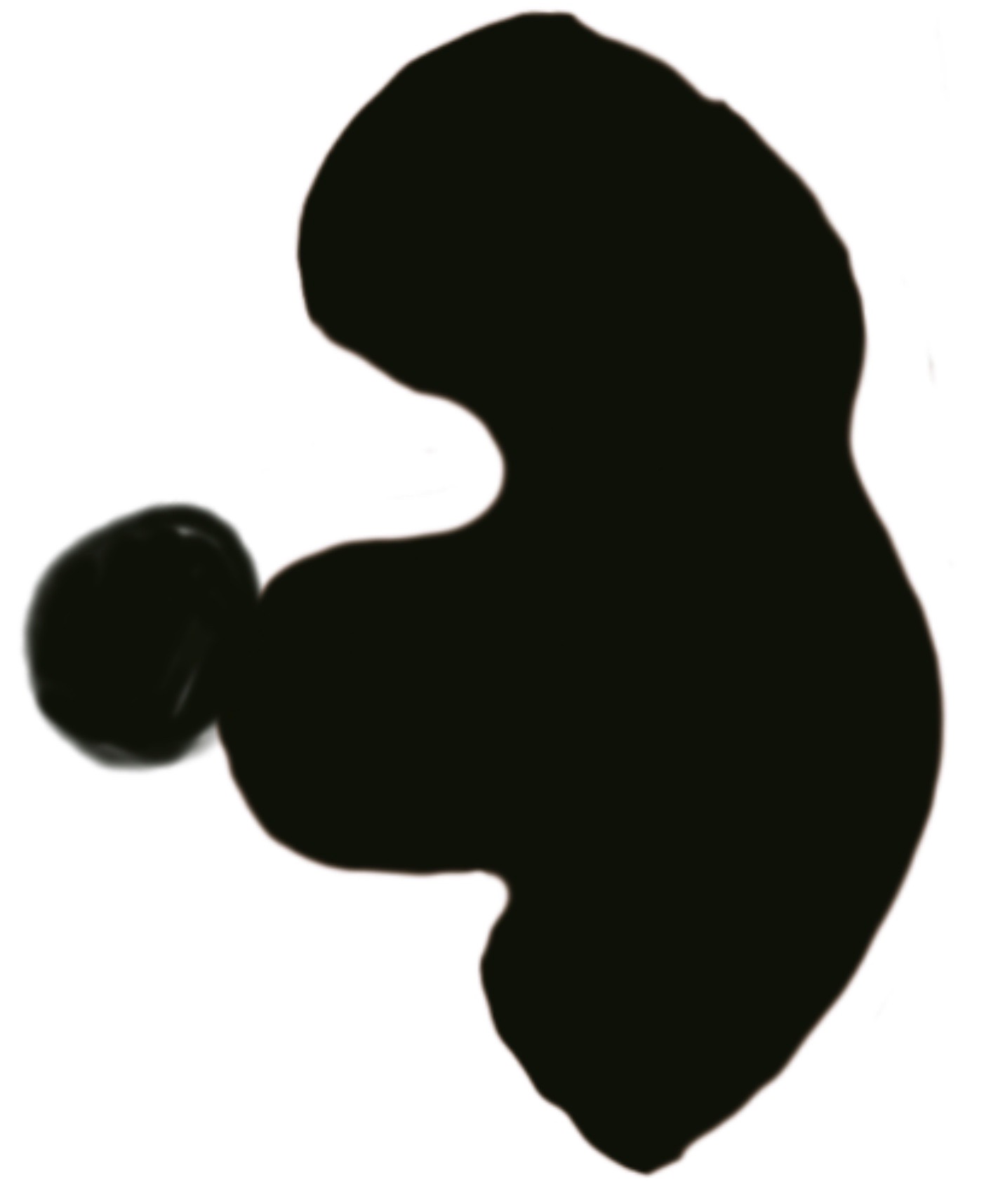
I counted six times, as I drew in a shape without plan. Filled in with ink, this is how it looked.
The Blob
Aha, a Rorschachian moment!
I recognized the first thing that jumped out.
Take a look at it before you read my blog. Record your observations if you so wish.
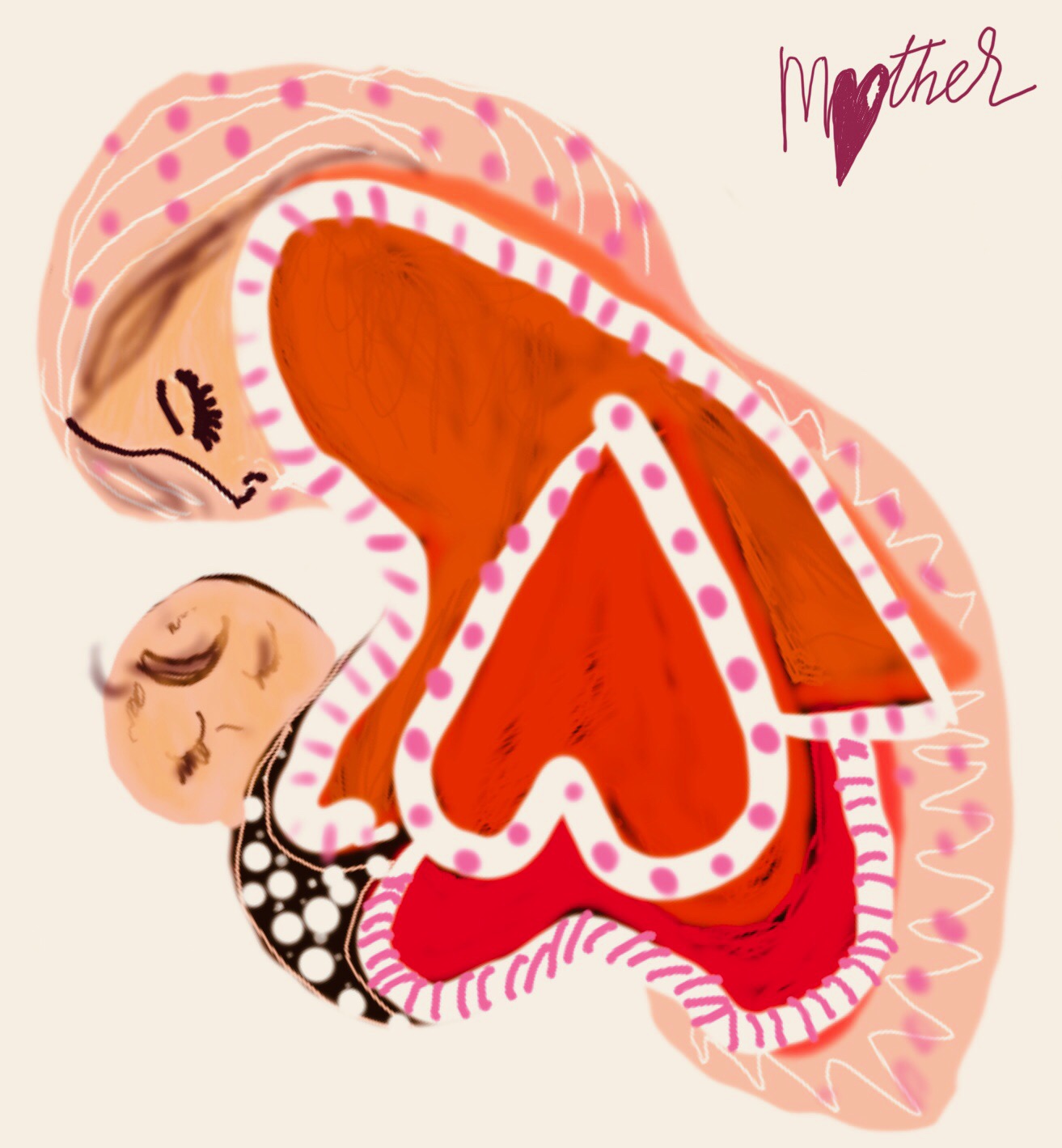
There she was!
I saw a mother, enrobed in compassion and love.
She popped out in all shades and colors. Say her name in different tongues. Matr, Mater, Mother, Madre, Mutter, Mata, Mama, Maman, Ma, and Mom, there’s something universal about her.
Transformation of Blot with Colors
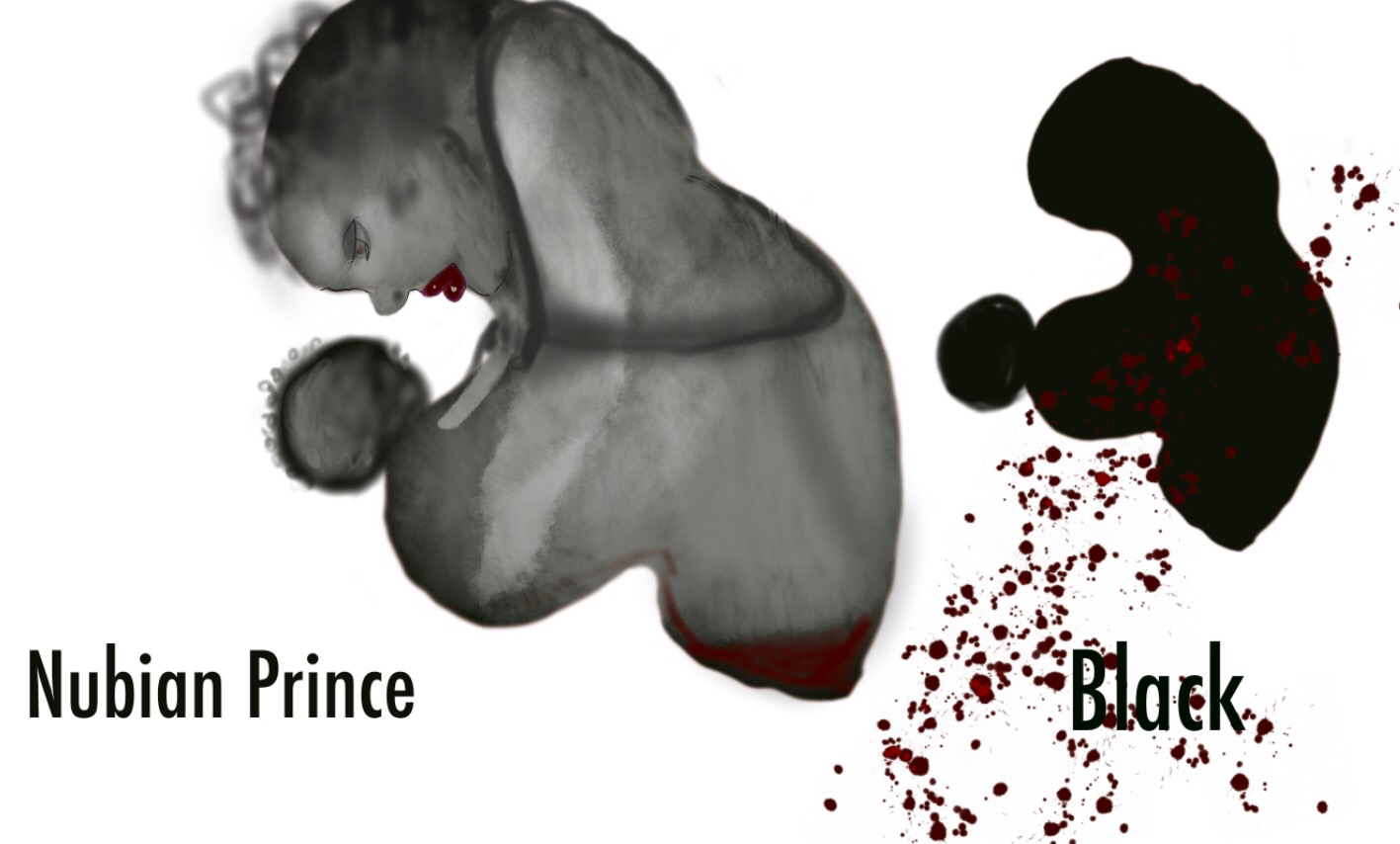
Yes, mothers are the same everywhere. With ease, I pull up another from the blot.
Fiercely proud of her son, this mother’s love is not any different from the other. Yet, she fears for his safety, even if both sons of different wombs share common blood of humankind
The polarized way of life today limits us to viewing humanity as black, brown, yellow, or white. We lose the opportunity to see who is really in front of us; another human being.
If an amorphous blot can be personified, why do we choose to reduce humanity to blobs?
The color pencils with their sharpened tips look like a harmonious wheel.
I pick up the watercolor pan. The perfection of each brick gnaws at my soul. I put it back.
The jeweled acrylic colors lie within paint tubes. I just cannot bring myself to squeeze, let alone dent their plump fullness.
I run my hands over the crayons intact in the clear covering. Why does my finger fear to blunt their sharp edges?
Overwhelmed by the color pastels, the brushes, the markers, I realize I must use them. The voice in my head mocks, “So you think you’re an artist!”
The graphite pencils are unsharpened.
“They look so perfect just the way they are,” I sigh.
My eyes take one last look to see the eraser before closing the lid.
“You can always do over,” it silently seems to convey.
I open the box wide, pick up the sharpener next to the forgiving eraser, and watch the spirals of wood coming off the pencils to slowly reveal the charcoal inspiration.










 theinkybee.com