The Bride

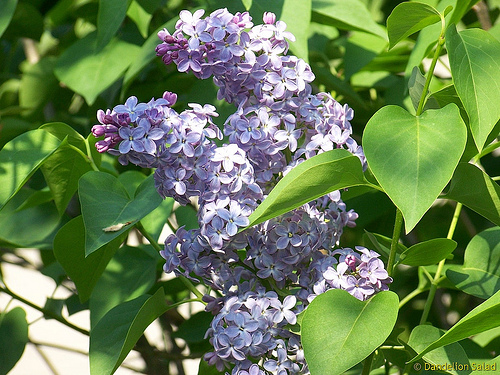
Photo Courtesy Wikimedia Commons

One by one she collected her trousseau items, as she lay waiting for the day that never came. It disappeared under the sun, the falling leaves, and somehow got buried under.

The blanket, it suffocates and squashes her every thought. He left without a word but took away her everything. Daggers hang on eaves, and she’s in a deep freeze mode. She no longer responds to the slightest rustle. There are no more footsteps, and the callbacks are frozen in her throat. She is tired and worn.

Stark, cold, and spartan..that’s her world now. The Glory Box has morphed into the blanket chest with fuzzy, pristine white blankets. The desert-like hoariness hurts the gaze. Her skin feels cold as alabaster, and the bones ache.

A sanguine youth feels locked away from her reach, and there’s no memory of how it once felt. No creature visits her, neither a butterfly nor a bee. The road yesterday is no longer familiar, and there are no comforting spaces. She has buried everything. Where is that park bench they sat together as one? Where is that park? The old landmarks are gone, along with their angles and familiar paths. Is her memory fuzzy, or is it a temporary squall? It covers and stifles everything she sees, and the fog in her mind rises like a shroud.

There is no glow in the embers, and it mirrors how she feels. Dull, ashen and cold, she is like her desire within. The fight made way to temperance, followed by restraint, and now it is securely locked in abstinence.

The rebellion first rolls in like a silent cat. While she sleeps, golden mustard flowers bask in the gentlest sun. She remains unmoved, but a slow thaw has begun.

Something hurtles down in full force, nearly knocking her down. It blasts the icy shell with a wrecking ball. Confused, she is forced to stir out of an imposed immobility. The glacial heart betrays a vulnerability in front of Life’s virile force. Armor shattered, she lets the twitter, buzz, and sights take her captive! This much profusion after much parsimony, it feels unbearable! That candy floss of pink stages and orchestrates a prolific rebellion against everything she long denied herself. Puffs of mini roses pop like fireworks. They climb chaotically everywhere. Unsteady, she tries to hold ground, but an inebriation takes over, ending that long abstinence.

The invasion of brides in their white wedding cake gowns make her yearn again. Dizzy blossoms like confection and candy, in riotous colors with their fresh fragrance, and buzzing honeybees unsteady her gait. The scents, the sights remind her about something, but she’s not going to reason. Frenzied and feverish, she does not notice new stirrings within. Renewed, she rushes to act without remembering. What could it be? WHAT IS IT? It does not come back fully, but she knows she must throw something out to dig something up.

She opens the blanket chest. The white snows have all melted away, leaving behind bunches and bunches of jocund daffodils that gloriously toast, “Here’s to Hope!”

Double Delight

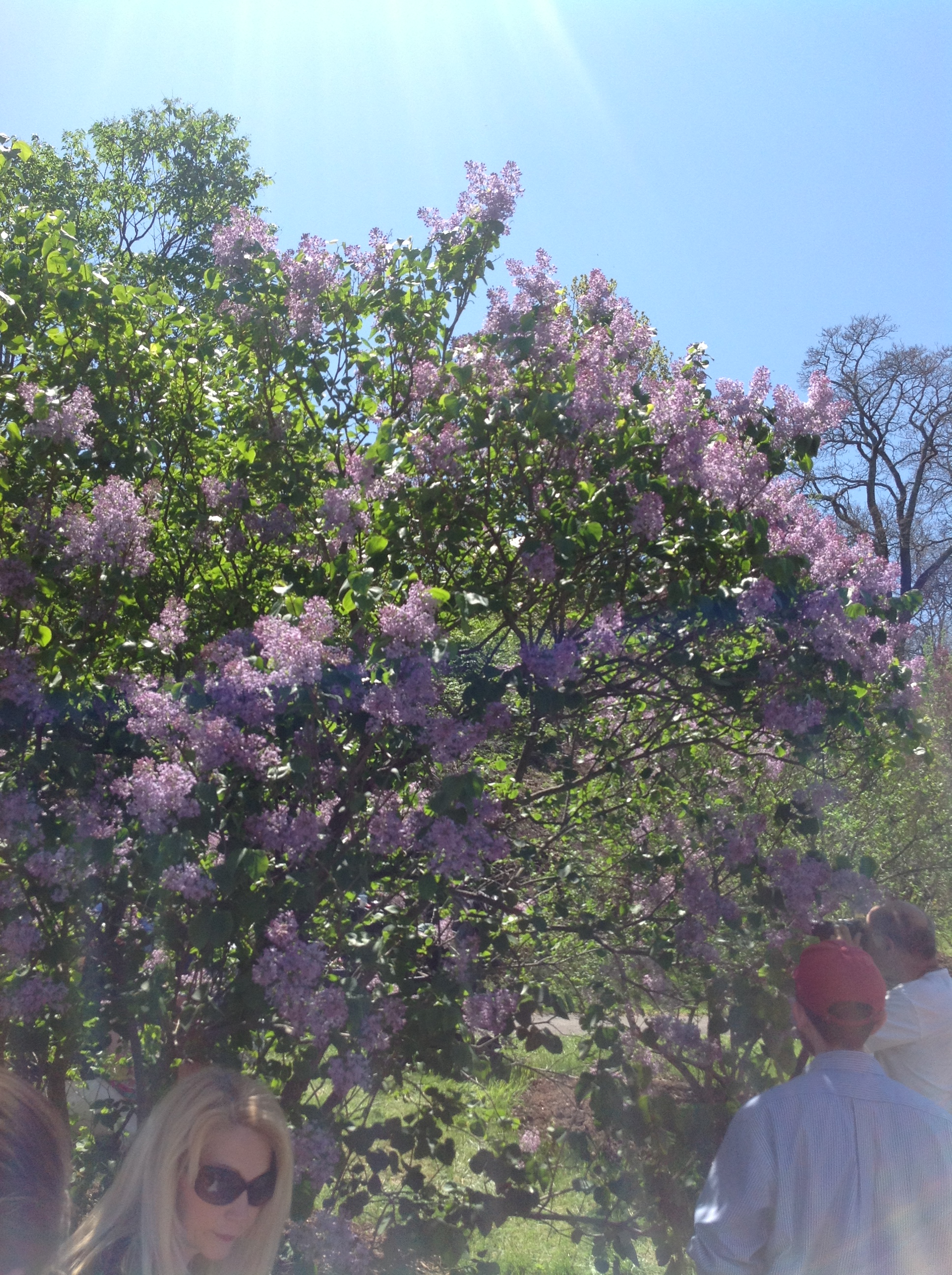
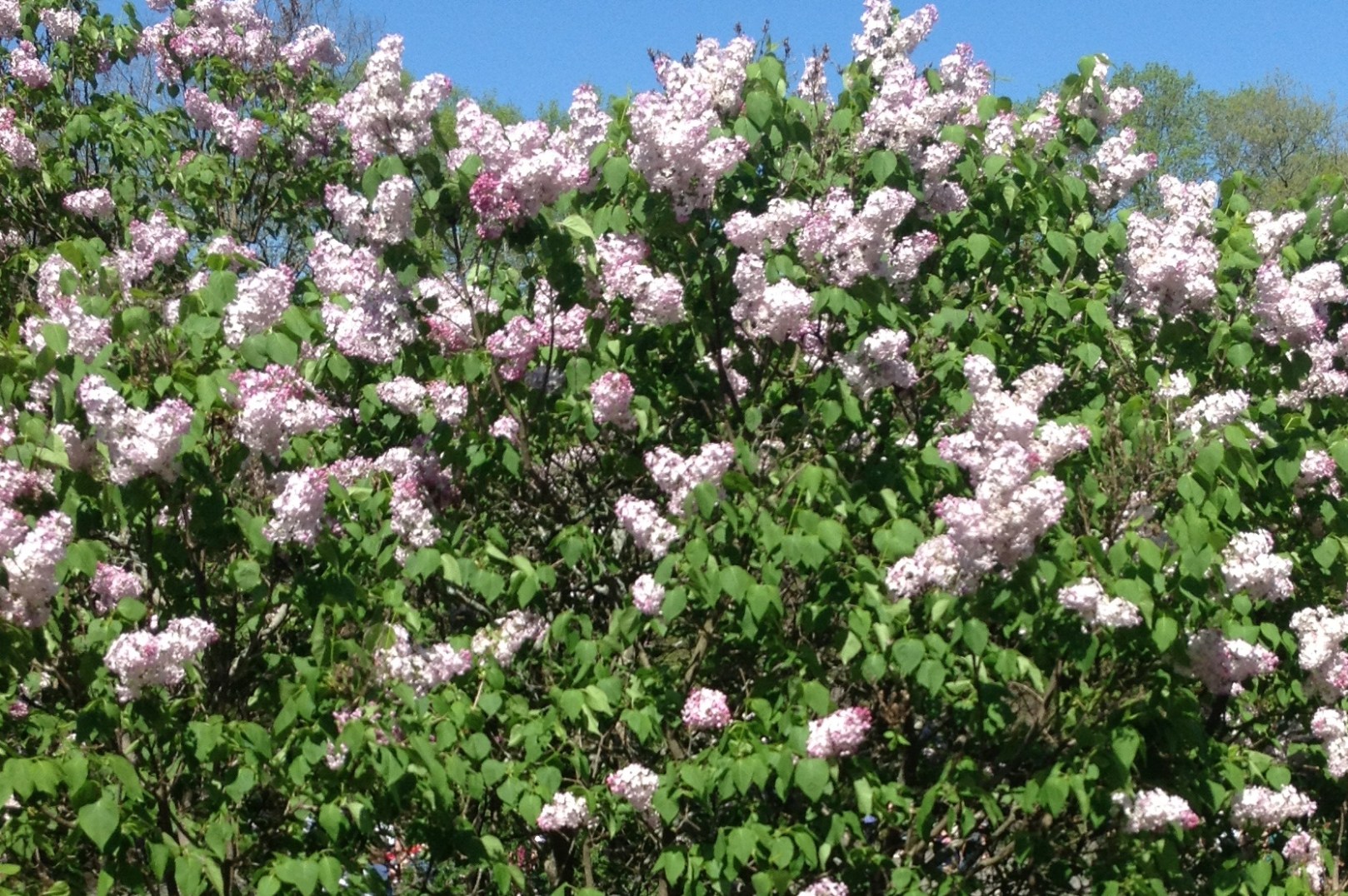
Lilac Sunday 2014 at the Arnold Arboretum, fell on Mother’s Day. What a fragrant surprise!

Lilac Sunday at the Arnold Arboretum is a yearly treat for all senses.  Now a Boston tradition, it surely is a family day of lilac tours, ambling in the arboretum, picnicking, or savoring variety of foods from different vendors. My visit in 2014 happened to fall on a hot and humid Mother’s Day. Lilac Sunday ended up being fragrant, colorful, and delightful, and the arboretum pulled in large crowds.

Jack Alexander they say, has been working here for about 38 years or so. He is a plant propagator who calls himself a “lilac student,” but his vast subject knowledge, expertise, personal experiences, and interesting anecdotes contradict this somewhat humble self-conferred title. We were fortunate to have him as our guide.

Preconceived notions and a bit of lilac history

The Lilac, reminiscent of grandma’s English kitchen garden, is actually an import even to Western Europe. It owes its origins to the Far East.  The Bard never mentions it in any of his work, even though he refers and alludes generously to various other flora. Lilacs however are also part and parcel of North American history, although it is hard to believe these are not native.  Jefferson and Washington, the garden enthusiasts, have recorded planting and transplanting lilacs in the eighteenth century.

A lilac by any other name simply cannot be the same

The Arnold Arboretum collection houses about 400 lilac plants of nearly 200 varieties. A majority of these are cultivars, there are also some wild species.  Plant breeders and horticulturists handpicked varied cultivars through the years for their hardiness, color, size, fragrance.. The blooming season is also varied, lasting approximately 5 weeks.  The season peaks midMay to continue on. The tour of lilacs dotting the lush landscape on Bussey Hill Road is a veritable delight to all senses. Each variety has a tale, and it’s a fun adventure to tag the collection. Here is a sampling of just a few.

From a seed gifted by Beijing Botanical Garden came  about the birth of the Arboretum’s cultivar, the Syringa Chinesis, ‘Lilac Sunday. Since 1908, this annual LIlac Sunday event is a treat for all lilac lovers.

Syringa Vulgaris is the common lilac.  There are several varieties of these. At the arboretum, it is easy to play favorites.

Common Lilac

Common Lilac

‘Syringa vulgaris,’  President Lincoln

President Lincoln

This shrub has a single flower of medium blue, the buds are purply-black.  It is pleasantly fragrant, and  it is considered the “benchmark” blue of lilacs. The various lilac blossom varieties can be all be described as to how purple or blue they are using the President Lincoln standard. This is a desirable variety, aptly dedicated to a true blue patriot.

Syringa vulgaris,  ‘Frederick Law Olmsted,’

Frederick Law Olmsted

Frederick Law Olmsted

This shrub is named for America’s first landscape architect (co-designer of Arnold Arboretum and Central Park) It’s a tall and compact shrub. These grow vigorously,  and they have an unmistakable fragrance with prolific white blooms.

Syringa oblata, dilatata, ‘Cheyenne’

Syringa oblata, var. dilatata, 'Cheyenne'

Syringa oblata, var. dilatata, ‘Cheyenne’

A native to Korea and its China borders,  the ‘Cheyenne’ came to the arboretum from Korea. It puts forth abundant blooms, blooms early, and is quite resistant to powdery mildew. Aside from its prolific ‘lilac’ blooms, it boasts of a pleasant fragrance. In addition, some of its foliage turns a beautiful maroon in autumn.

Syringa x hycanthiflora, ‘Asessippi,’

Asessippi

Asessippi

introduced in 1932, the ‘Asessippi’  one of the first hybrids released by F.L.Skinner. This shrub abundantly produces blooms all over, not leaving the lower branches.  Hardy and resistant to disease, the blooms are a true lilac color. It’s a popular choice. The scent is notable, and it is definitely a shrub that makes you pause in your tracks.

Syringa, ‘Purple Haze’

Purple Haze

Purple Haze

‘Purple Haze’ was introduced as recent as 2005 by Jack Alexander, our tour guide and the plant propagator of the arboretum. The parents of this specimen on tour  are the syringa oblata + syringa protolaciniata. Alexander named this cultivar ‘Purple Haze,’ as he associated the blooms with the song by Jimi Hendrix. The blooms are a pale lavender, and these are moderately scented. This variety is sterile; the blooms do not go to seed. Hence gardeners are spared the onerous job of deadheading spent blooms.

Syringa hyacithiflora, aka the Necker

Syringa hyacithiflora, aka the Necker

Necker

The Necker variety at this time had put out heady, profuse pinkish blooms. It has become another favorite of mine. Really, how many favorites can one have?

The late blooming Miss Kim variety came from the best of seven seeds collected from Korea. Miss Kim is noted for the intense fragrant flowers, at this time there were only buds on the shrubs. So it is good to make several visits through the lilac blooming season.

Lilac Sunday ended up being a Double Delight in 2014. Yes, there are double petaled varieties dotting the hillside, but it is the fact that Lilac Sunday fell on Mother’s Day that made it a true gift.  Aside from these varieties, it’s easy to visualize the Sugar Plum Fairy dancing in spring, see the Bloomerang shrub blooming sporadically over summer. Some varieties here go on to having a late summer second bloom. While the California Pink blushes on, the Charles Joly turns a dark purple. These are just a few of the many beautiful varieties abounding the arboretum.

As Alexander shows off the Nokomis variety, he passionately recites Longfellow. It becomes easy to understand why one visit simply is never enough. While the blooming season is shortlived, it’s comforting to anticipate the return next spring. So enter the Arboretum link to know more, and  save the date in advance. It’s time well spent.

http://arboretum.harvard.edu/news-events/lilac-sunday/?wpmp_switcher=mobile