The visit to a local spice farm in Zanzibar turned out to be sugar, spice, and everything nice.
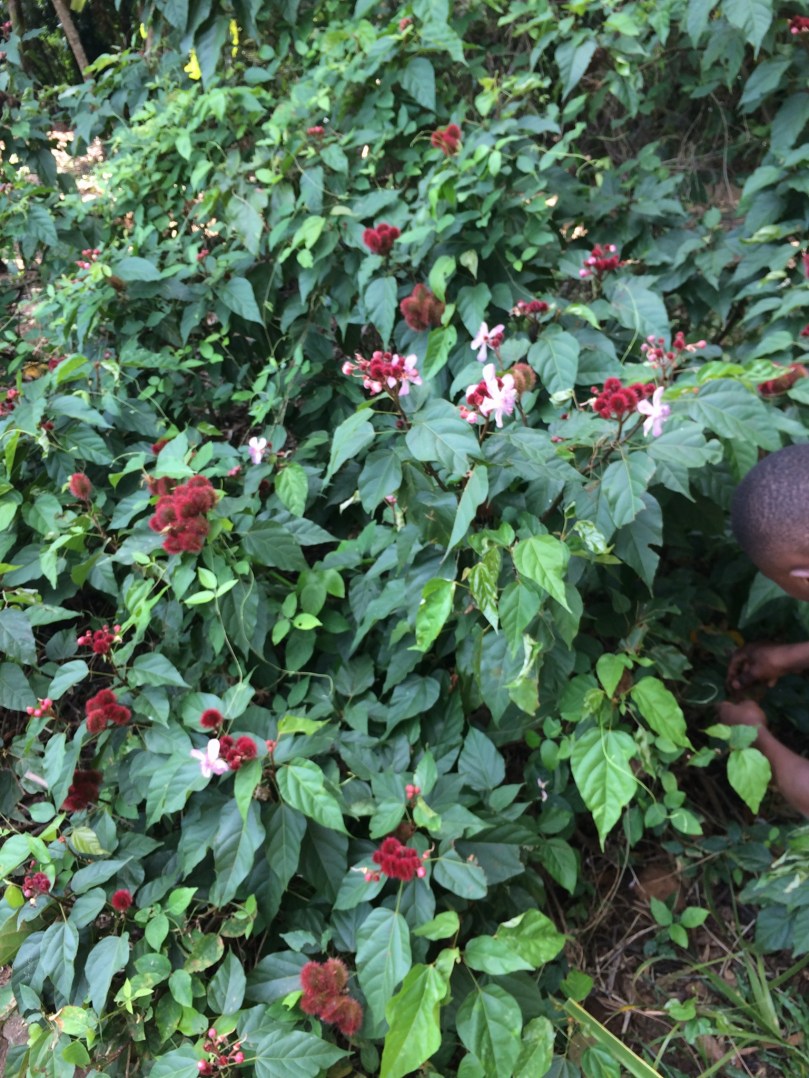
Lipstick Annatto
It’s a sun-bleached Zanzibar island kind of day in summer, as we take a tour of Mganga Spice Farm. From our hotel in Stone Town, it’s approximately a 23-mile drive interspersed with ocean views, local houses, resorts, and lush foliage. As we reach the entrance to the shaded spice farm, our taxi driver introduces us to our tour guide. His name is Babu, and he’s a jolly islander.
“Mganga,” he starts with a poker face, “sounds like a witch doctor, but it means a traditional herbalist.” Although the twinkle in his eye betrays what’s to come, we have no idea of the laughs and irreverent humor ahead of us.
Meandering through the farm, he introduces and sometimes personifies several varieties of plants with a somber look.
In the beginning, he shows us vines with bunches of pepper hanging on them. They cling to other plants and trees. “You get green, red, or black pepper depending on the stage of ripeness.” Pepper today sits innocuously on the dining table. Who can say it’s one major cause for great voyages, explorations, expeditions, and discoveries?
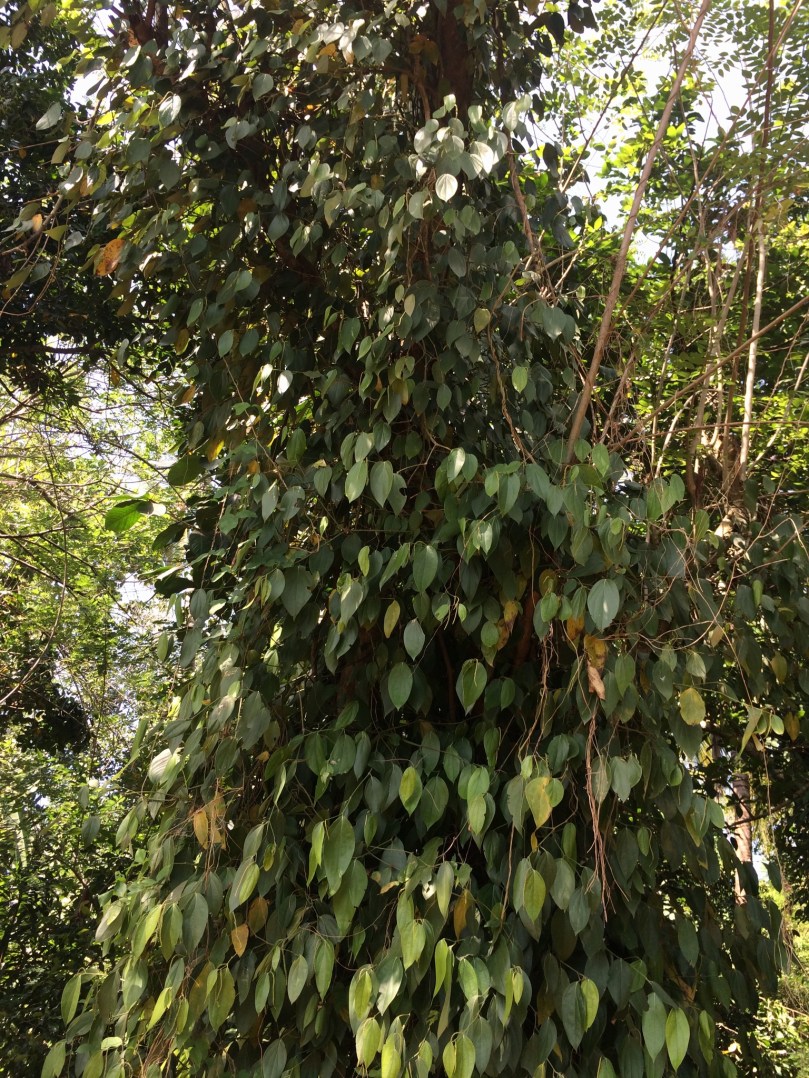
Pepper vines
The breadfruit is a cross between mulberry and jackfruit. Our tour guide warns us about indulgence. “If you like it too much, then make sure you are close to a toilet.” He takes one look at our quizzical faces and drops these words in a calculatedly casual manner. “Oh, I think I must explain to you that breadfruit’s used to relieve constipation.” He reiterates this important aspect of overindulgence when we brush past the allspice plant. “This spice,” he informs, “helps digestion and to relieve pain.”
We walk by the cardamom plant, often used as a mouth freshener. “I call cardamom the chewing gum designed for drunk drivers,” chuckles our guide. Green cardamom costs more than black cardamom. It’s widely used in Indian desserts due to its unique aroma.

Cardamom
Smiling, we walk through the spices, while a sweet-natured young man about thirteen years quietly joins us. His name is Mohammed, and he’s shy in contrast to Babu’s loquacious humor.
We pass the turmeric plant, and our guide extols its virtue as an antiseptic. “Want to know why we call the turmeric root Michael Jackson?” he asks us. We nod, and he cackles, “because you can change color when you use it” We do not know where to look. But he’s not finished. “Look, there are the red bananas.” We look up to see bunches of fruit hanging from the banana trees. “We call it Mzungu banana, because it looks like a white person has stayed a little too long in the sun.”
I temporarily look away from Babu, not knowing how to react. I see young Mohammed collecting leaves and flowers. However our guide reclaims our attention by pointing to the jackfruit tree. The fruits hang on the trunks with their spiky outsides. “I call this Jack Daniels,” he says in his characteristic way. We cannot repress our smiles. Jackfruit is sweet, flavorful. Rich in vitamins, flavonoids, and fiber, it can also be a meat substitute for vegetarians before it ripens too much.
“Let me introduce you to the King and Queen,” pronounces Babu with a flourish. The clove is the king of spices. The reasons are many. The fragrant clove is one of the chief exports of Tanzania. It’s a preservative, flavor enhancer, has anti-inflammatory qualities, and it provides relief, especially for dental pain. “Clove is king because it cannot be attacked….” He briefly pauses and continues, “yes, our king clove cannot be attacked by ants.” He goes further to tout its ant repelling properties. Eugenol is the aromatic oil in clove. Insects stay away from it, and several commercial insecticides contain this oil.


He’s not done with royalty. “I will soon make you the king and queen,” this anointer cryptically declares. I wonder what he means, but I don’t ask.
We pass curry leaves used extensively in Indian cooking, valued for its anti-diabetic properties as well as its unique flavor. Ginger tubers pop out of the ground in their abundance. Ginger can be used to combat nausea and settle digestion.
We brush against the fragrant lemongrass. Mohammed pulls a stalk out, and we inhale the fresh scent. Lemongrass complements tea well, and it also is a good essential oil. Babu mentions they often burn lemongrass to repel mosquitoes.
He soon points to a tree and calls it the lipstick plant, His young assistant picks a bright fruit-like pod out of it, and stains his lips with crushed seeds. It is the annatto plant, and the seeds are used to color food and add flavor. It’s a substitute for the more expensive saffron.


Natural Band-Aid
Long, green pods hang on a shrub nearby. “Vanilla can be a fussy plant,” informs our guide. It comes from the orchid family. The flowers bloom only once, and it must be quickly pollinated, otherwise it withers away with no seed pods. Bees unlike Netflix are most often not available on demand. Thus, vanilla flowers must carefully be hand pollinated. The guide also shows us nutmeg and mace. Nutmeg is the seed and mace is the seed covering. Nutmeg has a sweetish, warm taste. It’s used in baking desserts, puddings, and eggnog. Mace is the spice derived from the reddish aril or seed covering. Its delicate spice is used to flavor meats and used in pickling.

Nutmeg


The spice tour has made me giddy, and I buy a small amount of the aromatic wares. Let me warn you these are cheaper at the market.
It’s time to savor some of the fruits of the farm. Our young companion sources coconut palm leaves, flowers, and leaves, while Babu joins us at an outdoor table. We savor sweet pineapple, sweet mango, and watermelon.
As we drink in our surroundings, we notice a young man adeptly scrambling up the coconut tree. He has an amazing voice, as he soulfully sings in Swahili, “Zanzibar Hakuna Matata.” He drops young coconuts for us to enjoy.

Meanwhile Mohammed has finished his handiwork. Wordlessly he hands the many jewels made from the found flora. He has fashioned crowns, bracelets, rings, a hat, a basket, and even a tie fit for the newly minted “king.” They’re beautiful!
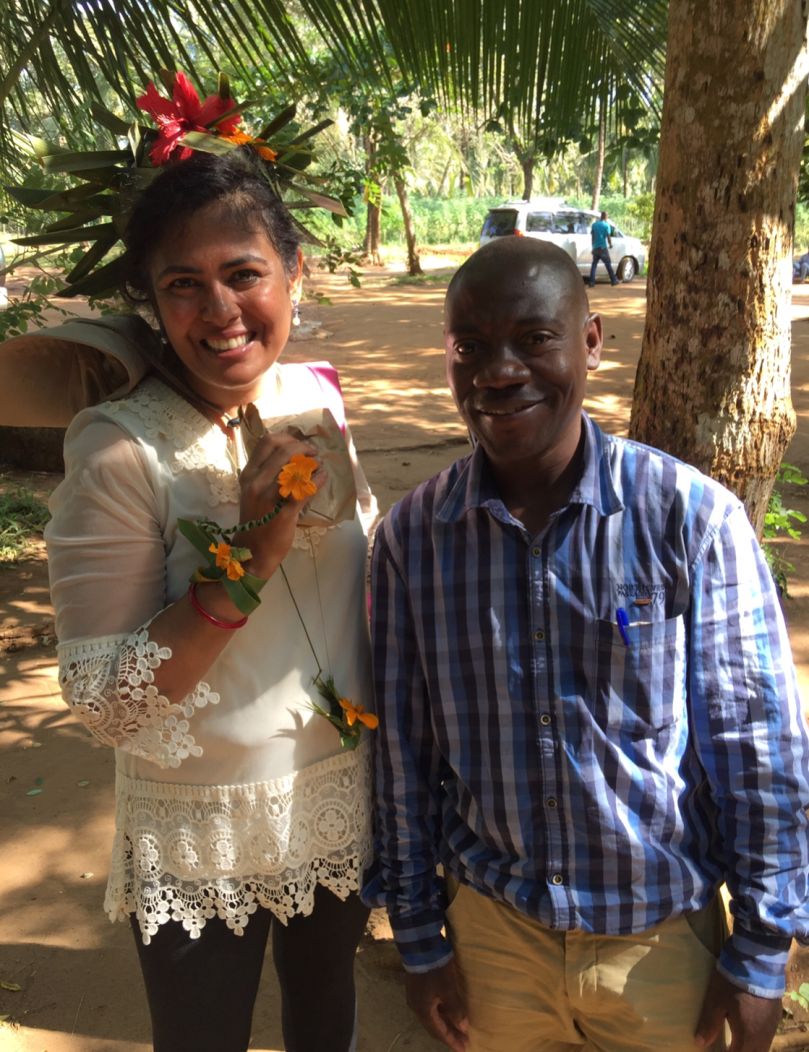
Author standing with the humorous tour guide Babu
After coronation, we officially title our tour guide “The Royal Maker.” Without a decree, he obliges to become the royal photographer of the moment.
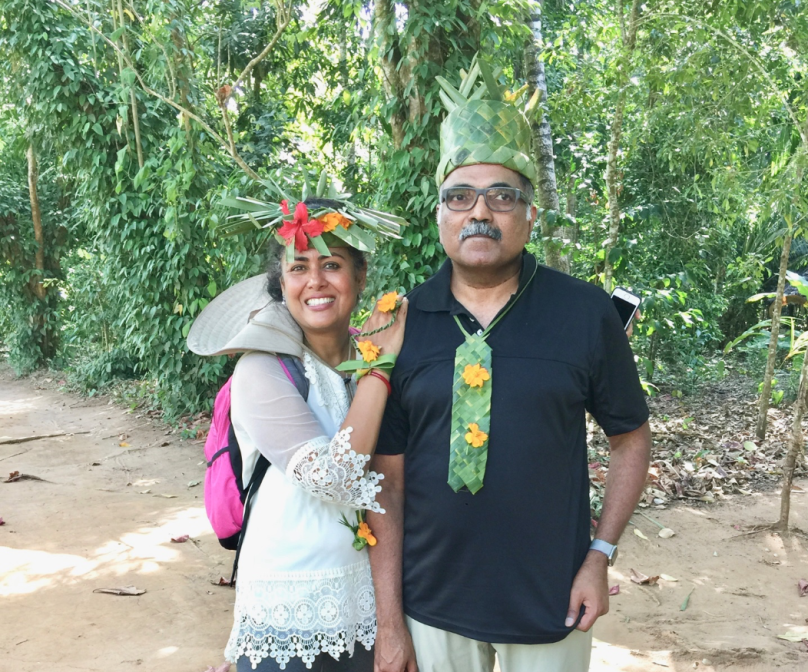
The King and I
The freshly crowned king summons his carriage. The taxi driver arrives with a huge smile to take us back to Stone Town in a right royal manner.


 theinkybee.com
The visual feast with your vivid descriptions helped me travel to Zanzibar & I thoroughly enjoyed the read .
And our queen Indu is looking resplendent in all her handmade regal accessories
LikeLike
Thank you dear RV for your kind words
! It was a fun and funny tour indeed!
LikeLike
Thank you!
LikeLike
I like that
LikeLike