
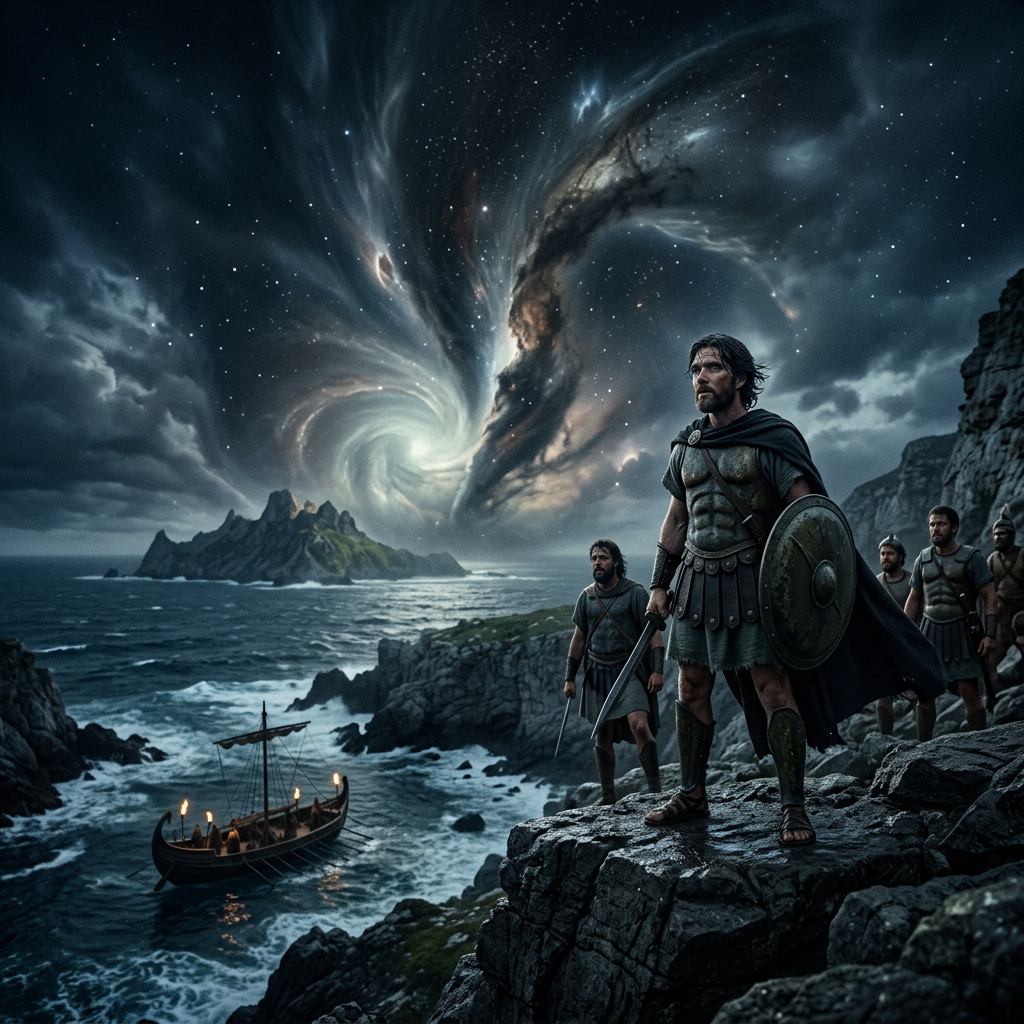
To dismiss Christopher Nolan’s The Odyssey as an over-compressed bastardization of ancient Greek poetry is to miss how myth actually works. Gatekeeping classicists and purists clutching their pearls over narrative liberties forget a foundational truth: Homer’s epic was never meant to be preserved in amber. It was an oral tradition that was visceral, adaptive, and tailored to the immediate anxieties of its listeners. Nolan was clearly inspired by Homer not to treat the text as a static historical relic, but to view it through the lens of our current times. By translating this mammoth poem into a tactile, IMAX-scale cinematic experience, he gave viewers a fresh doorway to interpret the story in our own way and rekindle a genuine interest in Homer’s original work.
It’s my opinion that today’s audience does not need a polished, museum-grade fable about divine intervention. Nolan’s casting choices were never an issue to the movie, nor was depicting Helen and her legendary beauty. Everyone in this vision carries the physical and psychological toll of a ruined decade. In Nolan’s world, there are no airbrushed idols; everyone wears scars. Odysseus (Matt Damon) is not an untouchable titan. He is a bone-tired, morally fractured survivor carrying the crushing weight of war and endless delay.
Nolan’s thematic masterstroke lies in his handling of xenia-Zeus’s sacred law of hospitality, which he frames not as a blank check for entitlement, but as a razor-sharp reflection of privilege, civic boundary, and migration in our own zeitgeist. Host-guest relations demand mutual responsibility, a contract modern audiences understand through the lens of displacement and borders. Odysseus and his crew were never invited into the cave of Polyphemus; they broke every rule of proper conduct, trespassing and gorging on cheese before demanding gifts. Polyphemus was not a monster, but a reclusive, hard-working cheese-making “artisan” minding his own business in a cave, whose tranquil life was invaded by entitlement. Likewise, the violent suitors in Ithaca were never legitimate guests, abusing hospitality through lawless consumption.
Where host-guest rules are honored, order prevails. Telemachus travels to Pylos and Sparta as a dutiful guest, waiting to be greeted, observing foreign customs, and honoring his hosts before asking for help. In turn, the Phaeacians model proper asylum, offering refuge and safe passage to a broken traveler who respects their domain. Xenia is a fragile social contract; when respected, it yields sanctuary, but when exploited, it breeds ruin.
Crucially, Nolan rejects the cheap, weightless CGI gimmickry that plagues modern blockbusters. Instead, he grounds ancient myth in stark physical reality through massive animatronics, punishing real-world locales, and raw practical effects. Circe’s surreal menagerie and metamorphic illusions are brought to life through elegant animatronic sleight of hand rather than digital pixels. When the crew encounters the Cyclops, Nolan builds an imposing practical creature that brings a sharp touch of dark humor to the screen, turning the epic encounter into a clash between unwanted invaders and an overwhelmed local craftsman.
Nolan brilliantly translates Homer’s other ancient hazards into the psychological traps of our own era:
- The Lotus-Eaters and Sirens: The seduction of digital numbness, outrage bait, and cheap validation that tempts us to abandon real progress.
- Hubris: The brilliant mind that repeatedly trips over its own ego, turning hard-won victories into disastrous detours.
- Institutional Rot: A crew torn apart by paranoia and a home front decaying under lawlessness, capturing our pervasive fear that the systems meant to protect us will unravel from within.
Above all, Nolan anchors the film in the dark, post-war reality of the veteran’s homecoming and the profound truth that the home you left is no longer the home you return to.
Forged in the cultural shadow of modern conflicts from the Gulf to Afghanistan, Nolan’s vision treats Odysseus’s return not as a victory lap, but as an agonizing re-entry. Decades of trauma and hypervigilance make stepping back into civilian life feel like entering a second battlefield. The kingdom has moved on, the survivor has changed, and the war inside the soldier lingers long after the physical fighting stops.
Homer will always have his secure, immortal place in western literature. But as a viewer, Nolan’s film did something invaluable: it brought the text off the dusty academic shelf, gave us room to find our own meaning within it, and reminded us why this journey has echoed across three millennia. By the way, these comments are opinions, and I can safely say I watched the whole movie unlike many commenters who probably never did.

